ADHD and Emotional Eating: Why Food Can Feel So Hard to Control
Jun 09, 2026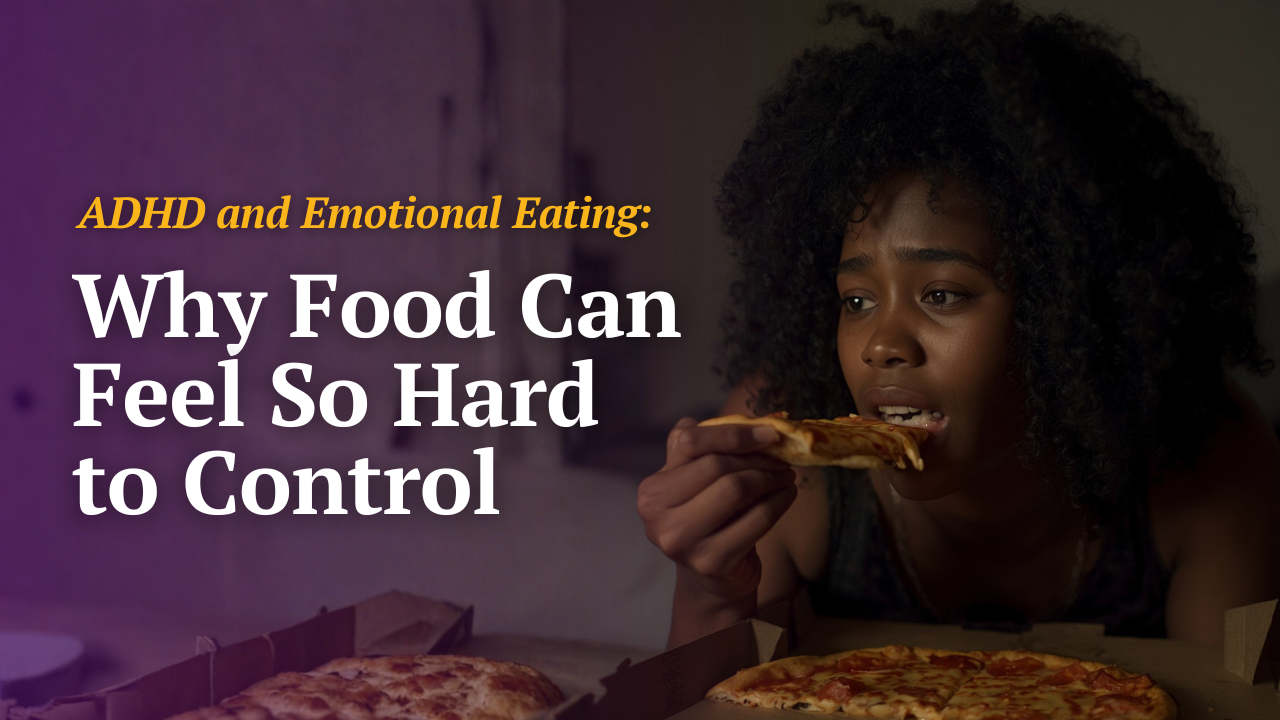
She said it quietly, like she was confessing something shameful.
“I think about food all the time.”
Not because she was greedy. Not because she lacked discipline. In many areas of her life, she was thoughtful, intelligent, and highly capable. But food carried a charge that felt bigger than hunger.
Food rewarded her. Comforted her. Stimulated her. Helped her focus sometimes. Helped her numb out other times.
And when life became stressful, exhausting, lonely, or overstimulating, the pull toward food became even stronger.
What made it harder was the shame.
She kept telling herself she should “know better” by now.
But ADHD changes the relationship many people have with food in ways that are neurological, emotional, and deeply tied to regulation.
The ADHD Brain and the Search for Dopamine
ADHD is connected to differences in dopamine regulation and reward processing (Volkow et al., 2009). Dopamine helps drive motivation, interest, pleasure, and focus.
Food—especially highly processed foods rich in sugar, fat, and salt—can create a quick dopamine response. For an understimulated ADHD nervous system, that temporary boost can feel grounding, energizing, soothing, or emotionally relieving.
That’s why many adults with ADHD describe:
-
intense cravings
-
eating for stimulation instead of hunger
-
hyperfixation on certain foods
-
binge-restrict cycles
-
difficulty stopping once they start eating
This isn’t simply about willpower.
It’s often about the nervous system trying to regulate itself using the fastest available tool.
Emotional Eating Isn’t Always About Emotion
Sometimes people hear “emotional eating” and assume it only means eating because you’re sad.
But many adults with ADHD eat because they are:
-
overwhelmed
-
under-stimulated
-
mentally exhausted
-
dysregulated
-
seeking transition relief
-
trying to create comfort after masking all day
Food can become:
-
a reward
-
a pause button
-
a source of predictability
-
a sensory experience
-
a dopamine boost
-
a moment of relief
And because eating temporarily works, the brain keeps returning to it.
Until shame enters the picture.
Then the cycle often becomes: Stress → eating → relief → guilt → restriction → rebound eating → more shame.
The issue isn’t a lack of intelligence. It’s that many people are trying to solve a nervous system issue with self-criticism. And self-criticism rarely regulates anything.
Try This: Supporting the ADHD Nervous System Without Shame
1. Pause Before Eating—Without Forcing Yourself to Stop
What it is: Creating awareness before automatic eating.
Why it works: Awareness interrupts autopilot and builds nervous system insight.
How to do it: Before reaching for food, ask: “What am I needing right now besides food?” Not to deny yourself—just to notice.
2. Build More Dopamine Into Your Life Intentionally
What it is: Creating stimulation outside of eating.
Why it works: ADHD brains seek dopamine wherever they can find it.
How to do it: Add small sources of pleasure and activation throughout the day: music, movement, sunlight, novelty, creativity, laughter, connection.
A nervous system that receives enough stimulation is less likely to seek all of it from food.
3. Stop Using Shame as Motivation
What it is: Replacing self-attack with curiosity.
Why it works: Shame increases stress, and stress often increases impulsive eating.
How to do it: When you overeat, skip: “I have no control.”
Try instead: “What was happening in my nervous system today?”
That question opens the door to understanding.
4. Make Eating More Structured, Not More Punitive
What it is: Supporting consistency without extreme restriction.
Why it works: Rigid rules often backfire in ADHD nervous systems.
How to do it: Aim for predictable meals with protein, fiber, and satisfaction instead of swinging between overcontrol and impulsivity.
Stability helps reduce urgency around food.
Coming Back to the Shame
As our work continued, she realized something important. Food wasn’t her enemy. It had become one of the ways her nervous system tried to care for her—even if imperfectly.
Once she stopped treating herself like a failure, she became more curious about what she actually needed: rest, stimulation, comfort, structure, support.
The shame began to loosen.
ADHD can absolutely complicate a person’s relationship with food. But healing rarely comes through punishment.
It comes through understanding what the brain has been trying to solve all along.
And from there, change becomes possible. If you’ve been struggling with food, shame, impulsivity, or feeling like your brain is constantly working against you, you do not have to figure it out alone. Sometimes the missing piece is understanding how ADHD may be shaping your nervous system, habits, and relationship with regulation.
I offer a free ADHD consultation call where we can explore what you’re experiencing, what patterns may be showing up beneath the surface, and what support could look like for you.
⟶ You can book a free consult here
References
Barkley, R. A. (2015). Attention-deficit hyperactivity disorder: A handbook for diagnosis and treatment (4th ed.). Guilford Press.
Volkow, N. D., Wang, G. J., Fowler, J. S., & Telang, F. (2009). Dopamine in drug abuse and addiction: Results from imaging studies and treatment implications. Archives of Neurology, 66(11), 1364–1372.