ADHD and Overcommitting: Why You Say Yes to Everything (and How to Stop)
Mar 18, 2026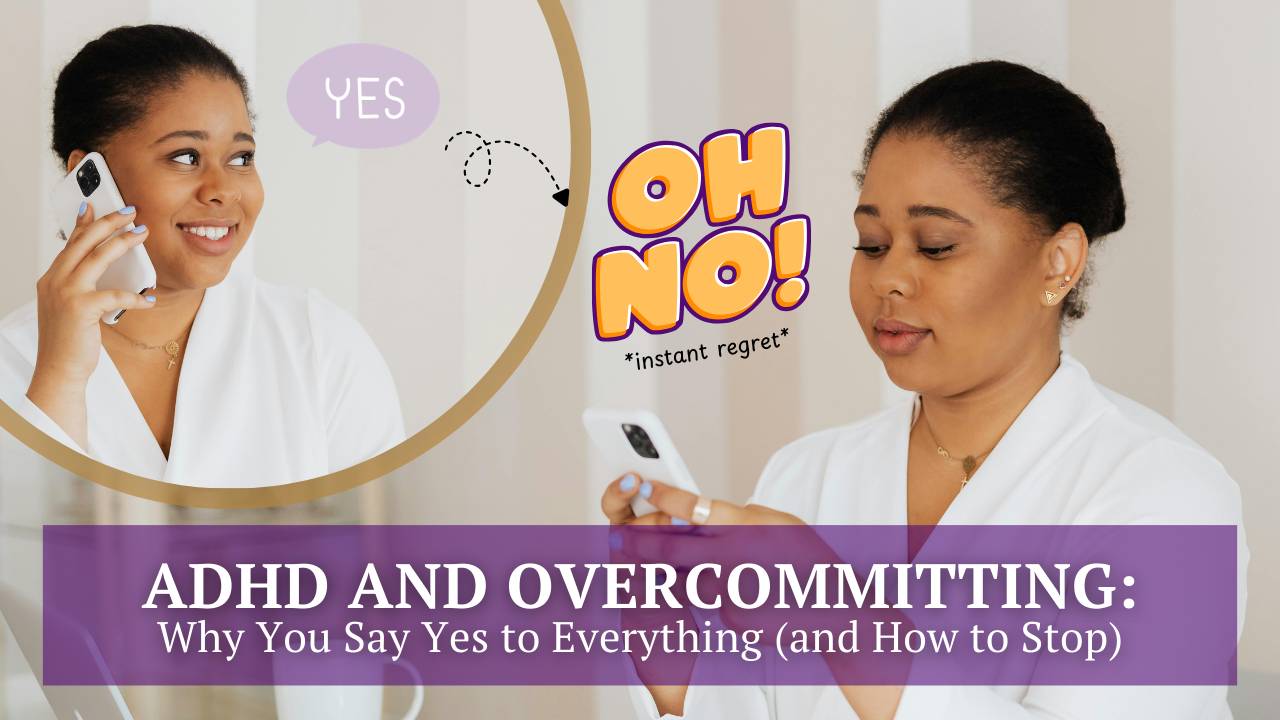
My coaching client laughed when she said it.
“I don’t even remember deciding. I just hear myself saying yes.”
Yes to the committee. Yes to the dinner. Yes to helping. Yes to staying late. Yes to something she absolutely does not have the capacity for.
And then, hours later—or days later—the weight settles in.
Why did I agree to that?
Overcommitment in ADHD isn’t usually about ambition. And it isn’t always about people-pleasing, either. Often, it’s about speed.
The ADHD brain moves quickly. Faster than reflection. Faster than capacity checks. Sometimes even faster than conscious choice.
And when “yes” comes out before thought has fully formed, life starts to feel crowded.
What’s Actually Driving the Quick Yes
ADHD affects impulse control and response inhibition (Barkley, 2015). That doesn’t only show up as blurting things out or interrupting. It can also show up as committing before pausing.
In the moment, saying yes can feel:
-
exciting
-
generous
-
aligned
-
urgent
-
relieving
But neurologically, something else may be happening. The brain responds to novelty and possibility with a burst of dopamine. That surge can create a temporary sense of clarity or enthusiasm—even when long-term capacity hasn’t been evaluated.
Add emotional sensitivity into the mix, and another layer appears: the desire not to disappoint.
Research shows adults with ADHD often experience heightened rejection sensitivity and social stress (Bunford et al., 2015). Saying yes can momentarily reduce the discomfort of potentially letting someone down.
So the yes serves multiple functions:
-
avoiding rejection
-
chasing stimulation
-
maintaining connection
-
feeling useful
The problem isn’t the yes itself.
It’s the lack of pause before it.
Intuition vs. Impulsivity
This is where it gets nuanced.
Many adults with ADHD are intuitive. They read energy quickly. They feel momentum. They sense alignment in real time.
But intuition feels grounded.
Impulsivity feels urgent.
Intuition is steady. Impulsivity is fast.
One leaves you expanded. The other often leaves you drained.
Learning to distinguish the two can change everything.
Try This: Interrupting the Automatic Yes
1. Install a Default Delay
What it is: A pre-decided pause before committing.
Why it works: It creates space between impulse and action.
How to do it: Practice saying: “Let me check my schedule.” Even if you think you know the answer. Especially then.
2. Scan for Urgency
What it is: Noticing the emotional speed behind your response.
Why it works: Impulsivity rides on urgency; intuition does not.
How to do it: Before answering, ask yourself: “Does this feel calm—or fast?” If it feels fast, wait.
3. Separate Discomfort from Danger
What it is: Recognizing that disappointing someone is uncomfortable, not catastrophic.
Why it works: Rejection sensitivity can distort perceived risk.
How to do it: Remind yourself: “Someone being briefly disappointed is not the same as losing connection.”
4. Check Capacity, Not Intent
What it is: Evaluating energy rather than enthusiasm.
Why it works: You can want to do something and not have the bandwidth.
How to do it: Ask: “If this were tomorrow, would I still want it on my calendar?” If the answer is no, reconsider.
Coming Back to the Pattern
When we revisited her pattern in therapy, she realized something quietly powerful.
She wasn’t irresponsible.
She was fast.
Once she began building intentional pauses into her responses, something shifted. She still said yes—but less reflexively. And when she said no, the relationships didn’t collapse.
They adjusted.
Overcommitment in ADHD isn’t a character flaw. It’s a speed issue combined with sensitivity and stimulation.
The goal isn’t to become rigid or closed.
It’s to let your yes come from steadiness instead of urgency.
That kind of yes doesn’t need to be undone later.
If you’re seeking support for ADHD and want help choosing someone who actually understands your brain and nervous system, I created a free guide: What to Ask Before You Hire an ADHD Therapist or Coach.
The right provider can help your life feel lighter and more doable. The wrong one can leave you feeling like you’re the problem. This guide helps you tell the difference—so the support you choose truly supports you.
⟶ Download the FREE guide here
References
Barkley, R. A. (2015). Attention-deficit hyperactivity disorder: A handbook for diagnosis and treatment (4th ed.). Guilford Press.
Bunford, N., Evans, S. W., & Wymbs, F. (2015). ADHD and emotion dysregulation among young adults. Journal of Attention Disorders, 19(6), 491–498.