Big Feelings, Fast Reactions: ADHD and Emotional Intensity in Parenting
May 19, 2026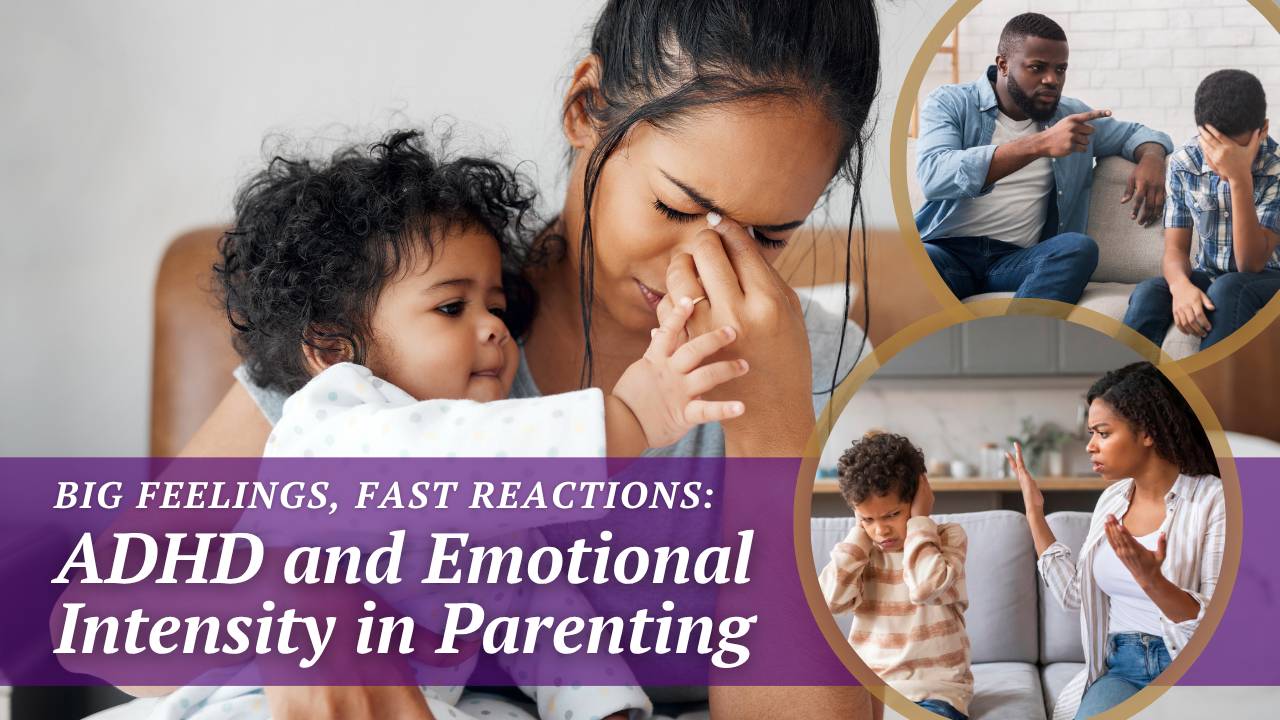
Danielle told me about a morning that had stayed with her.
She was already running late.
Her child couldn’t find their shoes. The clock kept moving. She felt the pressure building in her chest.
“Come on, we’ve talked about this!” she snapped.
And just like that, the moment shifted.
Her child’s face changed. The room got quiet. And almost immediately, Danielle felt it—that drop in her stomach.
“That’s not how I wanted to handle that.”
As she described it in our session, what stood out wasn’t just the reaction. It was how quickly it happened.
She paused for a moment before saying, almost quietly, “I don’t even recognize myself in those moments. It’s like I’m already there before I can stop it.”
If you’ve ever had a moment like that, you’re not alone. And more importantly—you’re not broken.
In my work, I often sit with parents who care deeply about how they show up, and who are genuinely confused by the speed and intensity of their reactions.
That word—fast—is important.
Emotional Intensity Isn’t a Character Flaw
ADHD is often discussed in terms of attention and focus, but emotional regulation is a significant part of the picture.
Research suggests that individuals with ADHD may experience emotions more intensely and have more difficulty modulating emotional responses in the moment (Shaw et al., 2014).
This can look like: • quicker reactions • stronger emotional responses • difficulty slowing down once activated
For Danielle, this wasn’t about not knowing what to do.
She knew.
It was about what happened before her thinking brain had a chance to catch up.
The Nervous System Moves First
In many of these moments, the nervous system is already activated before conscious awareness kicks in.
By the time you realize what’s happening, you’re already in it.
That’s why so many parents describe a familiar pattern:
react → regret → reflect → resolve → repeat
And again, the interpretation becomes the problem.
“I should be more in control.” “I know better than this.”
But “should” doesn’t slow down a nervous system.
What Actually Helps
One of the most important shifts in my work with Danielle wasn’t trying to eliminate her reactions completely.
It was helping her understand them.
When she began to see her reactions as fast-moving nervous system responses—not personal failures—something changed.
The shame softened.
And when the shame softened, she had more access to choice.
Not perfectly. Not every time.
But more often.
And that’s where real change began.
Try This
1.) Create a micro-pause
Why it works: Even a brief pause gives your thinking brain a chance to catch up with your emotional response.
How to use it: You don’t need silence or stillness—just a small interruption in the reaction.
Try this: Practice saying, “Give me a second,” or take one intentional breath before responding.
2.) Track your early signals
Why it works: Awareness of early body cues allows you to intervene before escalation.
How to use it: Notice physical signs like tension, heat, or urgency.
Try this: Ask yourself, “What does my body feel like right before I react?”
3.) Plan for repair
Why it works: Reduces pressure to be perfect in the moment and strengthens the relationship over time.
How to use it: Expect that rupture will happen and decide in advance how you’ll reconnect.
Try this: Use a simple script: “That came out sharper than I meant. Let’s reset.”
4.) Reframe the reaction
Why it works: Reduces shame, which improves emotional regulation over time.
How to use it: Shift from judgment to understanding.
Try this: Replace “What’s wrong with me?” with “What just got activated?”
Emotional intensity does not disqualify you from being a good parent.
In many cases, it’s part of what makes you responsive, passionate, and deeply connected.
The work is not becoming emotionless.
It’s learning how to move with your emotions—without letting them take over the whole room.
If you’re noticing yourself in these patterns and want support in navigating them, I offer free consultations to explore how coaching or therapy can help. You don’t have to figure this out on your own.
Disclaimer: The example above is a composite of multiple clients. Identifying details have been changed to protect confidentiality.
References
Shaw, P., Stringaris, A., Nigg, J., & Leibenluft, E. (2014). Emotion dysregulation in attention deficit hyperactivity disorder. American Journal of Psychiatry, 171(3), 276–293.