Procrastination Isn’t Laziness: What’s Really Happening in the ADHD Brain
Jan 27, 2026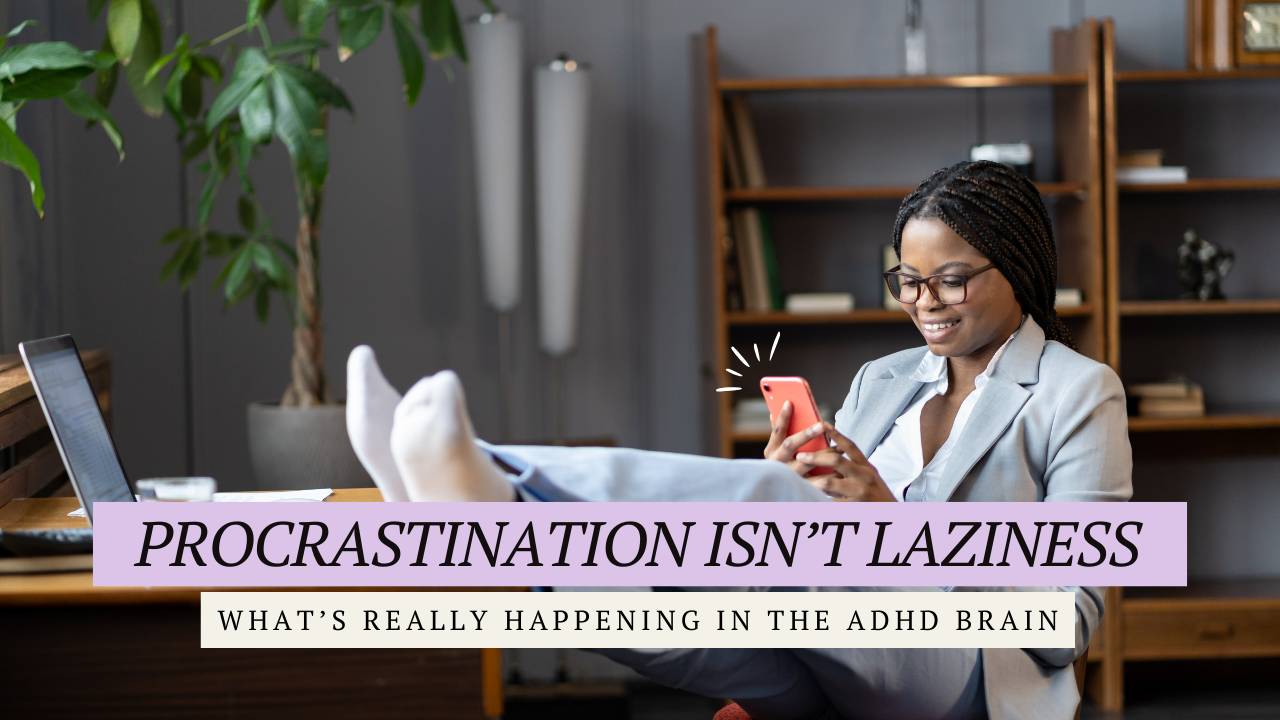
Why “Just Try Harder” Has Never Worked—and What Helps Instead
A client once said to me, half-laughing and half-defeated, “I know what I need to do. I even want to do it. I just… can’t start.”
That sentence holds so much truth for adults with ADHD.
Procrastination is usually described as avoidance, poor time management, or a lack of discipline. But when I sit across from clients who are stuck—scrolling, frozen, or circling the same task for days—I don’t see laziness. I see a nervous system that doesn’t feel safe enough to begin.
And that distinction matters.
Because when procrastination is misunderstood, people don’t just fall behind—they start turning on themselves.
What Procrastination Really Is in ADHD
In ADHD, procrastination is less about motivation and more about regulation.
Research shows that ADHD affects executive functioning—particularly task initiation, emotional regulation, and working memory (Barkley, 2015). When a task feels emotionally loaded, unclear, boring, or overwhelming, the brain’s threat system can activate faster than the planning system.
In simple terms: The brain senses discomfort → goes into protection mode → starting feels impossible.
This is why telling someone with ADHD to “just break it into smaller steps” often doesn’t help—especially if the nervous system is already flooded. The issue isn’t knowing what to do. It’s feeling resourced enough to do it.
Over time, repeated experiences of “I meant to, but didn’t” can quietly erode self-trust and reinforce shame, which only deepens the cycle.
Why Shame Makes Procrastination Worse
Many adults with ADHD grew up hearing messages like:
-
“You’re not living up to your potential.”
-
“You’re smart, but…”
-
“Why can’t you just do it?”
Those messages don’t motivate. They condition the brain to associate tasks with failure and self-criticism.
Neuroscience backs this up. When shame is present, the brain’s threat circuitry becomes more active, while the prefrontal cortex—the part responsible for planning and follow-through—goes offline (Schore, 2019). The result is what many people describe as paralysis.
Understanding this doesn’t excuse avoidance. It explains it—and explanation is where real change begins.
Try This: Working With Procrastination Instead of Fighting It
1. Name the State, Not the Flaw
What it is: Separating your identity from your nervous system state.
Why it works: Labeling reduces shame and increases cognitive flexibility.
How to do it: Instead of “I’m procrastinating again,” try: “My nervous system doesn’t feel ready yet.” That one shift often creates enough space to move gently forward.
2. Shrink the Start Until It Feels Almost Silly
What it is: Lowering the activation energy of the task.
Why it works: Small, non-threatening starts reduce the brain’s threat response.
How to do it: Don’t start the task. Start the environment: Open the document. Set the timer. Put the notebook on the table. Completion isn’t the goal—entry is.
3. Regulate First, Then Initiate
What it is: Addressing the body before the to-do list.
Why it works: A regulated nervous system restores access to executive functioning.
How to do it: Try 60–90 seconds of grounding: feet on the floor, slow exhale, name three things you can see. Then revisit the task.
4. Replace Urgency with Safety
What it is: Shifting from pressure-based motivation to trust-based momentum.
Why it works: Urgency activates fear; safety supports initiation.
How to do it: Ask: “What would help this feel safer or more supported?” That answer is usually more useful than another productivity hack.
When we stop treating procrastination like a personal failure, something softens.
That client I mentioned earlier didn’t suddenly become hyper-productive. What changed was how they spoke to themselves. They learned to recognize when their system was overwhelmed—and to respond with curiosity instead of criticism.
Progress didn’t come from pushing harder. It came from listening more closely.
Sometimes the most powerful shift isn’t doing more—it’s understanding what’s been asking for care all along.
If reading this resonated, you don’t have to navigate ADHD support alone. Download our free checklist: What to Ask Before You Hire an ADHD Therapist or Coach to find support that truly fits.
👉 Download the FREE guide HERE
References
Barkley, R. A. (2015). Attention-deficit hyperactivity disorder: A handbook for diagnosis and treatment (4th ed.). Guilford Press.
Schore, A. N. (2019). Right brain psychotherapy. Norton.