The Mental Load of Caregiving: Why You’re Exhausted (and How Therapy Helps)
May 26, 2026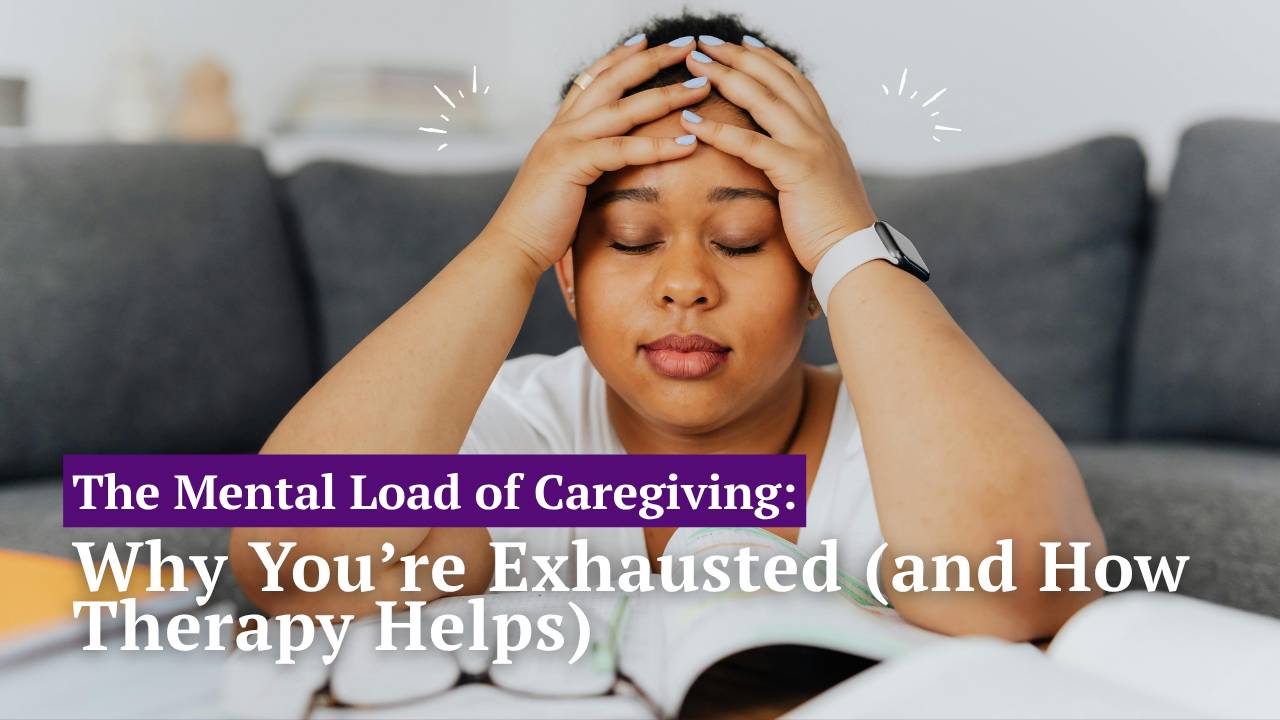
Motherhood is often described as rewarding, meaningful, even sacred. And it is.
But it is also relentless.
As part of my upcoming book, You Don’t Have to Be Crazy to See a Therapist, I’m sharing stories from my clinical work to demystify therapy and name the real experiences people carry—especially the ones that don’t get said out loud.
The stories in this series are drawn from my work as a psychologist. Identifying details have been changed, and some stories are composites of clients with similar experiences or themes.
The Weight You Can’t Put Down
Tasha didn’t come to therapy because she was falling apart.
She came because she was holding everything together.
“I’m not even sure what I need,” she told me. “I just know I’m tired in a way that sleep doesn’t fix.”
She worked full-time. Managed her household. Tracked school emails, doctor’s appointments, groceries, birthdays, emotional check-ins, and the unspoken expectation that she would remember everything.
“I feel like my brain never turns off,” she said. “Even when I sit down, I’m still running the list.”
That’s the mental load.
Not just doing the work—but carrying the responsibility of remembering, anticipating, and managing it all.
Research shows that mothers disproportionately carry this invisible cognitive labor, which is associated with increased stress, burnout, and decreased well-being (Daminger, 2019; Offer & Schneider, 2011).
Tasha wasn’t failing.
She was overloaded.
Decision Fatigue Is Real
During one session, she described snapping at her husband after he asked, “What do you want for dinner?” She reported yelling back at him, "I don't care, I make decisions all day!"
And she did.
From small decisions (snacks, schedules, logistics) to larger ones (school choices, discipline, finances), the constant demand to decide drains cognitive energy.
This is known as decision fatigue—the deteriorating quality of decisions after a long session of decision-making (Baumeister et al., 2008).
But in motherhood, the decisions don’t stop.
They stack.
And over time, even simple questions can feel like too much.
What Therapy Helped Her See
Tasha expected therapy to give her strategies.
What she didn’t expect was perspective.
“I thought I just needed to be more organized,” she said.
Instead, we slowed things down.
We named what she was carrying—not just tasks, but responsibility. Emotional labor. Anticipation. The constant scanning of everyone else’s needs.
Therapy helped externalize the chaos.
Instead of everything living in her head, we put it on paper. Mapped it. Looked at it together.
“You’re doing the work of multiple people,” I told her.
She sat back.
“I’ve never thought about it like that.”
That moment matters.
Because when everything lives inside you, it feels like you’re the problem.
When it’s externalized, you can finally see the system.
The Generational Layer
As we worked together, another layer emerged.
“I don’t want to parent the way I was parented,” she said. “But sometimes I hear my mother’s voice come out of my mouth.”
That awareness is common—and powerful.
Parenthood often activates unresolved experiences from our own childhood. Not because we’re doing something wrong, but because we’re seeing it from a new angle.
Research shows that parental stress and early attachment experiences shape caregiving patterns across generations (Belsky & de Haan, 2011).
Therapy creates space to pause that pattern.
Not by blaming the past—but by understanding it.
Tasha began to notice when she was reacting versus responding.
When she was parenting her child—and when she was responding to her own history.
“That’s not even about them,” she said once, catching herself mid-thought.
That’s the shift.
Boundaries, Support, and the Myth of Doing It Alone
“I should be able to handle this,” she told me.
That word—should—came up often.
Many mothers carry an internalized belief that needing help is failure. That strength means doing it all.
But no one was meant to parent alone.
Over time, Tasha began setting small boundaries.
Asking her partner to take full ownership of certain tasks—not “help,” but ownership.
Saying no to family expectations that added stress.
Letting go of doing things the “right” way in favor of doing them sustainably.
And slowly, she began to build something many people talk about but few feel they truly have:
A village.
Not perfect. Not constant. But intentional.
What Changed
“I still have a lot to do,” she told me. “But it doesn’t feel like it’s all sitting on my chest anymore.”
That’s what therapy can do.
Not erase responsibility—but redistribute how it lives inside you.
Not eliminate stress—but make it understandable, workable, and shared.
Motherhood will always require energy.
But it should not require self-erasure.
Try This
If you’re carrying more than you can name, start here.
1.) Identify one area of quiet overload
What it is: Noticing where your mind feels constantly “on” or preoccupied.
Why it works: Overwhelm becomes manageable when it’s named instead of carried unconsciously.
How to do it: Ask yourself, “What is taking up mental space even when I’m trying to rest?”
2.) Reduce one daily decision
What it is:
Removing the need to choose in one repeated area of your day.
Why it works: Decision fatigue decreases when routine replaces repeated choice.
How to do it: Pre-decide meals, outfits, or routines for a few days at a time.
3.) Notice the inherited voice
What it is: Recognizing when your reactions are shaped by your own upbringing.
Why it works: Awareness creates space between automatic reactions and intentional parenting.
How to do it: Pause and ask, “Is this about my child—or something I learned growing up?”
4.) Ask for real support
What it is: Requesting specific help with clear ownership.
Why it works: Vague requests lead to partial help; clarity leads to shared responsibility.
How to do it: Instead of “help me more,” say, “Can you fully handle bedtime three nights this week?”
If this resonated, I encourage you to share it with a mother who is carrying more than she lets on. These stories are part of my upcoming book, You Don’t Have to Be Crazy to See a Therapist, which explores what therapy actually looks like and how it helps people move from overwhelm to clarity.
If you’d like a practical next step, you can download my free guide, How to Interview a Therapist (So You Actually Find the Right One)—a guide to finding support that actually fits your life.
⟶ Download the FREE guide HERE
References
Baumeister, R. F., Vohs, K. D., & Tice, D. M. (2008). The strength model of self-control. Current Directions in Psychological Science, 16(6), 351–355.
Belsky, J., & de Haan, M. (2011). Annual research review: Parenting and children’s brain development. Journal of Child Psychology and Psychiatry, 52(4), 409–428.
Daminger, A. (2019). The cognitive dimension of household labor. American Sociological Review, 84(4), 609–633.
Offer, S., & Schneider, B. (2011). Revisiting the gender gap in time-use patterns. American Sociological Review, 76(6), 809–833.