Therapy and Cultural Competence: Why Your Therapist Must Understand Race, Context, and Reality
Feb 24, 2026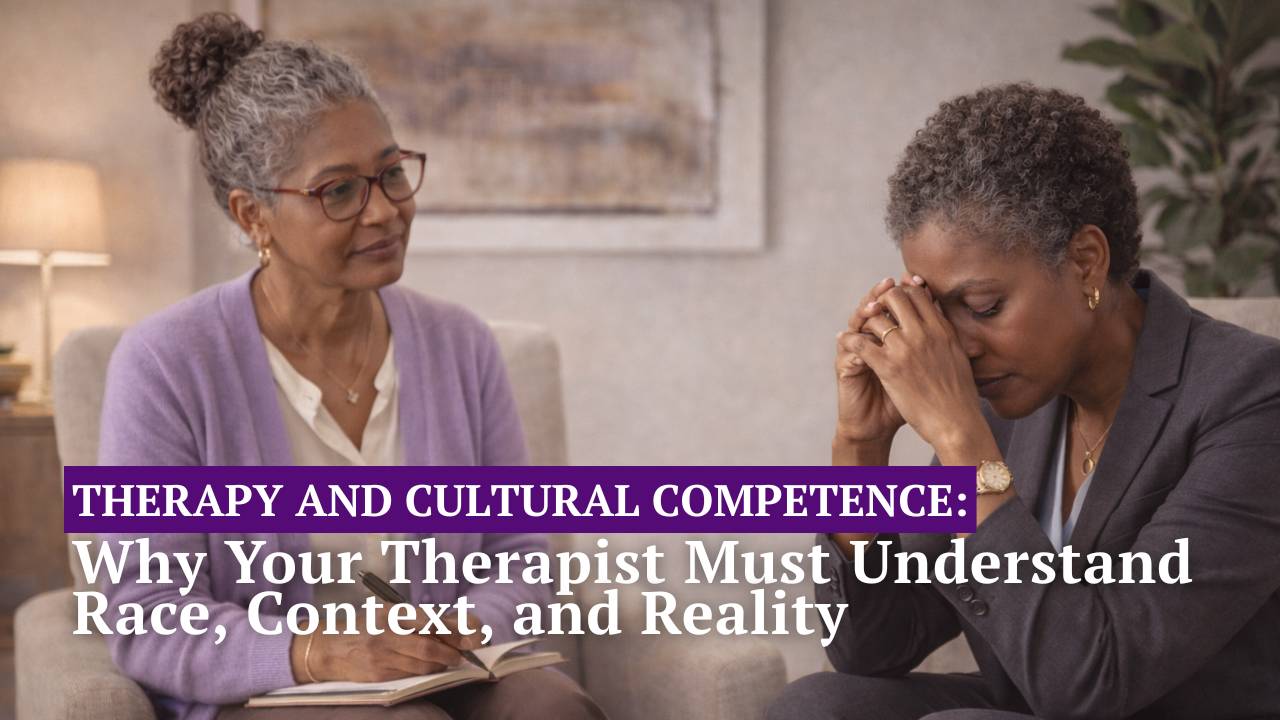
Therapy continues to feel inaccessible to many Black clients—not because help isn’t needed, but because the right support hasn’t always existed. Conversations about racial trauma, cultural mistrust, and lived experience are not abstract fears; they are grounded in history, context, and ongoing inequities that shape mental health care itself.
As part of my upcoming book, You Don’t Have to Be Crazy to See a Therapist, I’m sharing stories from my clinical work to illuminate what happens in therapy when cultural context is acknowledged—and when it’s missed. The experiences in this series are drawn from my work as a psychologist. Identifying details have been changed, and some stories are composites of clients with similar experiences or themes. My aim is to clarify what culturally responsive therapy looks like in practice, and why it matters deeply to so many people.
When Cultural Context Is Missed
Danielle came to me after trying therapy before.
“I brought up the fears I have for my teenage son,” she said. “With everything happening politically, the racial hostility… I’m scared. And my therapist just kind of… nodded.”
She paused.
“It felt like she thought it was all in my head.”
Danielle had been seeing a Caucasian therapist for several months. She had talked about work stress, co-parenting, and exhaustion. But when she brought up racism—specifically her fear about how policies and public rhetoric might impact her son—something shifted.
“I don’t need someone to agree with everything I say,” she told me. “But I need them to understand that this isn’t abstract. This is my child.”
That distinction matters.
This Isn’t Paranoia. It’s History.
For many Black parents, conversations about safety are not hypothetical. They are grounded in lived experience and historical context. Research consistently shows that racial discrimination is associated with increased psychological distress, anxiety, and hypervigilance (Williams & Mohammed, 2009). Fear is not pathology when it is tied to real patterns.
And mistrust of medical and mental health systems is not irrational. It is historically grounded. The legacy of the Tuskegee Syphilis Study, forced sterilizations, and disproportionate psychiatric institutionalization of Black patients contributed to deep and understandable skepticism toward healthcare systems (Suite et al., 2007). More recently, research has documented persistent racial disparities in diagnosis, including the overdiagnosis of schizophrenia among Black men and the underdiagnosis of mood disorders (Metzl, 2010; Schwartz & Blankenship, 2014).
This history shapes perception in the present.
It also shapes access. According to data from the American Psychological Association (2021), only about 4% of psychologists in the United States identify as Black or African American. And not all psychologists provide therapy—many work in research, assessment, academia, or administrative roles. That means the percentage of Black therapists available for ongoing clinical care is even smaller.
For many people, finding a Black therapist who has availability, takes their insurance, and fits logistically may not be possible.
This reality is one of the reasons I am writing You Don’t Have to Be Crazy to See a Therapist. I want people of color to understand what therapy actually is, to move past myths and stigma—but I am also realistic. Not everyone will be able to find a Black therapist.
That is why I created a guide on how to interview therapists. Because while racial concordance can matter, what matters just as deeply is cultural humility. You can find a white therapist—or a therapist from another cultural background—who has done the work. Someone who understands intersectionality. Someone who recognizes how the history of the United States continues to shape the lived experiences of Black clients today. Someone who listens instead of minimizes.
When a therapist responds with neutrality in a moment that calls for acknowledgment, it can feel like dismissal.
Danielle didn’t want outrage. She wanted context.
“I felt like I had to prove why I was scared,” she said. “Like I was overreacting.”
Research supports what many clients report. Perceived racial bias in therapy is associated with early termination and lower treatment satisfaction among Black clients (Whaley, 2001). When clients feel misunderstood or minimized, they often leave—not because they don’t want help, but because the space does not feel safe.
Strength Was Survival
Danielle also carried another layer.
“I don’t want to look weak,” she said. “Single mom. Strong Black woman. I’m supposed to handle things.”
That script runs deep.
In many families, strength was survival. Silence was protection. Therapy can feel like violating an unspoken rule: we endure.
Cultural Humility, Not Cultural Omniscience
What shifted in our work wasn’t that I knew everything about her specific subculture. I don’t. No therapist knows every lived nuance of every community.
What matters is this: when I don’t know something, I ask. Respectfully. Curiously. Without defensiveness.
When Danielle talked about fear for her son, I didn’t ask whether it was rational. I asked what it felt like in her body. I asked where it connected to her own experiences growing up. I asked what she needed in order to feel steadier.
“You’re not crazy,” I told her. “Your fear makes sense given what you’ve seen and lived.”
That acknowledgment changed the temperature in the room.
Good therapy does not require your therapist to share your background. But it does require cultural humility—the ability to recognize systemic realities and remain open to learning from the client (Hook et al., 2013).
You should not have to shrink your reality to make therapy comfortable for someone else.
You should not have to educate your therapist in order to be believed.
And you are not weak for wanting support while carrying both personal stress and collective weight.
What Feeling Understood Changes
Over time, Danielle stopped bracing in session. She didn’t have to soften her language—cussin’ is allowed in my sessions—or translate her fears. She could talk about parenting, politics, history, and exhaustion without feeling like she was being evaluated for overreaction.
“I don’t feel like I’m arguing for my reality in here,” she said once. “I feel understood.”
That’s the difference.
Therapy is not about erasing context. It’s about honoring it. When cultural realities are acknowledged—not minimized—healing feels possible.
References
American Psychological Association. (2021). Demographics of the U.S. psychology workforce. APA Center for Workforce Studies.
Hook, J. N., Davis, D. E., Owen, J., Worthington, E. L., & Utsey, S. O. (2013). Cultural humility: Measuring openness to culturally diverse clients. Journal of Counseling Psychology, 60(3), 353–366.
Metzl, J. M. (2010). The protest psychosis: How schizophrenia became a Black disease. Beacon Press.
Schwartz, R. C., & Blankenship, D. M. (2014). Racial disparities in psychotic disorder diagnosis: A review of empirical literature. World Journal of Psychiatry, 4(4), 133–140.
Suite, D. H., La Bril, R., Primm, A., & Harrison-Ross, P. (2007). Beyond misdiagnosis, misunderstanding, and mistrust: Relevance of the historical perspective in the medical and mental health treatment of people of color. Journal of the National Medical Association, 99(8), 879–885.
Whaley, A. L. (2001). Cultural mistrust and mental health services for African Americans: A review and meta-analysis. The Counseling Psychologist, 29(4), 513–531.
Williams, D. R., & Mohammed, S. A. (2009). Discrimination and racial disparities in health. Journal of Behavioral Medicine, 32(1), 20–47.
If this story resonated, I encourage you to share it with someone who may be curious about therapy but hesitant because they fear being misunderstood. These stories are part of my upcoming book, You Don’t Have to Be Crazy to See a Therapist, which explores common myths about therapy, what actually happens in the room, and how people use therapy not because they’re broken, but because they want to live with more clarity and grounded support.
If you’d like a practical next step, you can download my free guide, How to Interview a Therapist (So You Actually Find the Right One)—a practical guide to choosing a therapist who fits you, not the other way around. You’ll also be the first to know when the book is released and when new stories in this series are published.