When the Food Noise Stops: What Therapy Can Help You Understand
Jun 02, 2026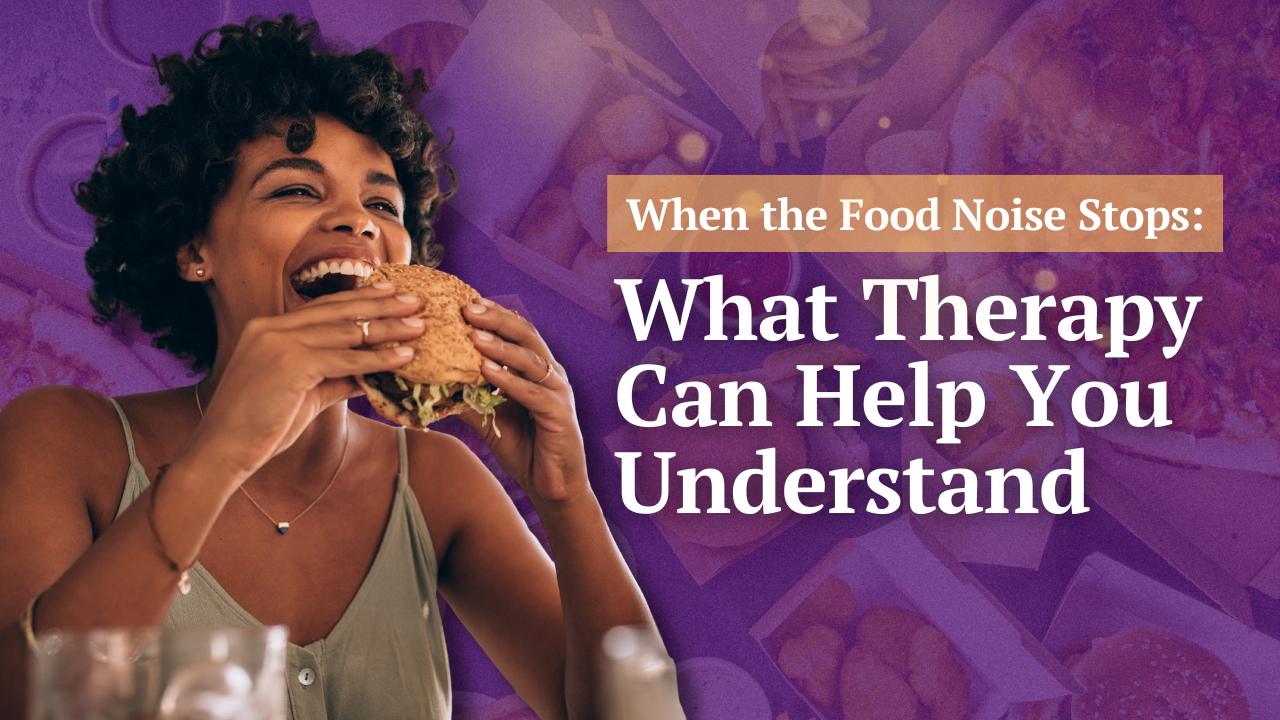
For many people, medications like Ozempic, Wegovy, and Mounjaro have been life-changing. Blood sugar improves. Weight begins to shift. Cravings quiet down. For some, the constant mental chatter around food finally becomes quiet for the first time in decades.
And for many people, that’s a relief.
But sometimes, underneath that relief, something unexpected emerges.
As part of my upcoming book, You Don’t Have to Be Crazy to See a Therapist, I’m sharing stories from my clinical work to help people better understand the emotional and psychological layers underneath everyday struggles—especially the parts that often surprise us.
The stories in this series are drawn from my work as a psychologist. Identifying details have been changed, and some stories are composites of clients with similar experiences or themes.
The Silence No One Prepared Her For
Melissa came to therapy excited about her progress.
Her A1c had improved. She was losing weight steadily. Her doctor was thrilled.
“And honestly,” she told me, “the food noise is just… gone.”
She paused after saying it.
“Which sounds amazing. But also weird.”
For most of her life, food had been more than food.
It was comfort. Reward. Relief. Celebration. Stress management. A way to soften loneliness, exhaustion, disappointment, and anxiety.
“If I had a terrible day, I ordered food,” she said. “If I had a great day, I celebrated with food. Everything revolved around it.”
Now, suddenly, the pull was gone.
And underneath that quiet, she found something she didn’t expect:
Emptiness.
“I thought I’d just feel healthier,” she admitted. “I didn’t expect to feel emotionally… untethered.”
That experience is more common than many people realize.
It Was Never Just About the Food
Research increasingly shows that eating behaviors are deeply connected to emotional regulation, reward pathways, stress response, and dopamine signaling (Volkow et al., 2013). Food is not simply fuel for many people—it becomes a coping mechanism, a source of stimulation, a distraction, a ritual, and a form of self-soothing.
GLP-1 medications can dramatically reduce appetite and food preoccupation, thereby improving both metabolic health and quality of life (Rubino et al., 2021). But when food has been functioning psychologically as well as biologically, removing the “food noise” can create an emotional vacuum.
Melissa described it this way: “It’s like I broke up with the most toxic relationship of my life… and now I don’t know what to do with myself.” That insight mattered. Because the goal was never just eating less. The deeper work was understanding what the eating had been doing for her emotionally.
The Emotional Adjustment Period
One of the hardest parts for Melissa was realizing how often she had used food to regulate feelings she barely noticed before.
Stress. Boredom. Loneliness. Overstimulation. Disappointment. Even joy.
Without food stepping in automatically, those emotions became more visible. And visibility can feel uncomfortable before it feels freeing.
Research on emotional eating suggests that many people use food to modulate distress and manage internal emotional states (Macht, 2008). When those patterns shift rapidly, people sometimes experience increased anxiety, irritability, or a temporary sense of emotional disorientation. Not because the medication is “bad.” But because adaptation is both psychological and physical. Melissa had spent decades building routines, rewards, and emotional regulation around food. Her mind needed time to reorganize.
What Therapy Helped Her Build Instead
At first, Melissa thought therapy would focus mostly on weight.
Instead, we focused on relationship.
Relationship to stress. Relationship to comfort. Relationship to her body. Relationship to herself.
“I don’t even know what I enjoy anymore,” she admitted one session.
So we got curious.
She started walking more—not as punishment, but because movement helped her think. She picked back up hobbies she had abandoned years ago. She learned to pause long enough to ask herself what she was actually needing in certain moments.
Not “What do I want to eat?” But “What do I need right now?”
That question changed things.
Over time, she began building new forms of reward, pleasure, grounding, and emotional regulation that were not entirely dependent on food.
And slowly, the emptiness stopped feeling empty.
It started feeling open.
Therapy Helps Fill the Space With Intention
One of the most important things therapy can offer during major health changes is meaning-making.
Not just: “How do I lose weight?”
But: “Who am I becoming now that this coping strategy is changing?”
Because sometimes, when symptoms improve, deeper questions emerge. That is not failure. That is growth. Medications can help quiet the noise. Therapy can help you understand what was underneath it.
Try This
If your relationship with food is changing, start here.
1. Notice the Moment Before Eating
What it is: Pausing briefly before reaching for food.
Why it works: It helps distinguish physical hunger from emotional need.
How to do it: Ask yourself, “What am I hoping food will help me feel right now?”
2. Build a New Reward System
What it is: Creating sources of comfort, pleasure, or celebration outside of food.
Why it works: The brain still needs regulation, enjoyment, and emotional release.
How to do it: Make a short list of activities that help you feel grounded, connected, calm, or energized.
3. Expect an Adjustment Period
What it is: Recognizing that emotional shifts during major behavioral change are normal.
Why it works: Self-judgment often decreases when experiences are understood in context.
How to do it: Remind yourself: “My mind is adapting too, not just my body.”
4. Get Curious Instead of Critical
What it is: Replacing shame with observation.
Why it works: Curiosity creates insight; shame usually creates avoidance.
How to do it: When emotions arise, ask: “What might this feeling be trying to tell me?”
If this resonated, I encourage you to share it with someone navigating changes in their relationship with food, weight, or emotional coping. These stories are part of my upcoming book, You Don’t Have to Be Crazy to See a Therapist, which explores the emotional realities underneath everyday struggles and how therapy helps people better understand themselves—not just their symptoms.
If you’d like a practical next step, you can download my free guide, How to Interview a Therapist (So You Actually Find the Right One)—a practical guide to finding support that actually fits your life.
⟶ Download the FREE guide here
References
Macht, M. (2008). How emotions affect eating: A five-way model. Appetite, 50(1), 1–11.
Rubino, D., Abrahamsson, N., Davies, M., Hesse, D., Greenway, F. L., Jensen, C., Lingvay, I., Mosenzon, O., Rosenstock, J., Rubio, M. A., Rudofsky, G., Tadayon, S., Wadden, T. A., Dicker, D., & STEP 4 Investigators. (2021). Effect of continued weekly subcutaneous semaglutide vs placebo on weight loss maintenance in adults with overweight or obesity. JAMA, 325(14), 1414–1425.
Volkow, N. D., Wang, G. J., Tomasi, D., & Baler, R. D. (2013). Obesity and addiction: Neurobiological overlaps. Obesity Reviews, 14(1), 2–18.*