Go Outside Before You Decide: Why My Best Decisions Rarely Happen at My Desk
Aug 04, 2026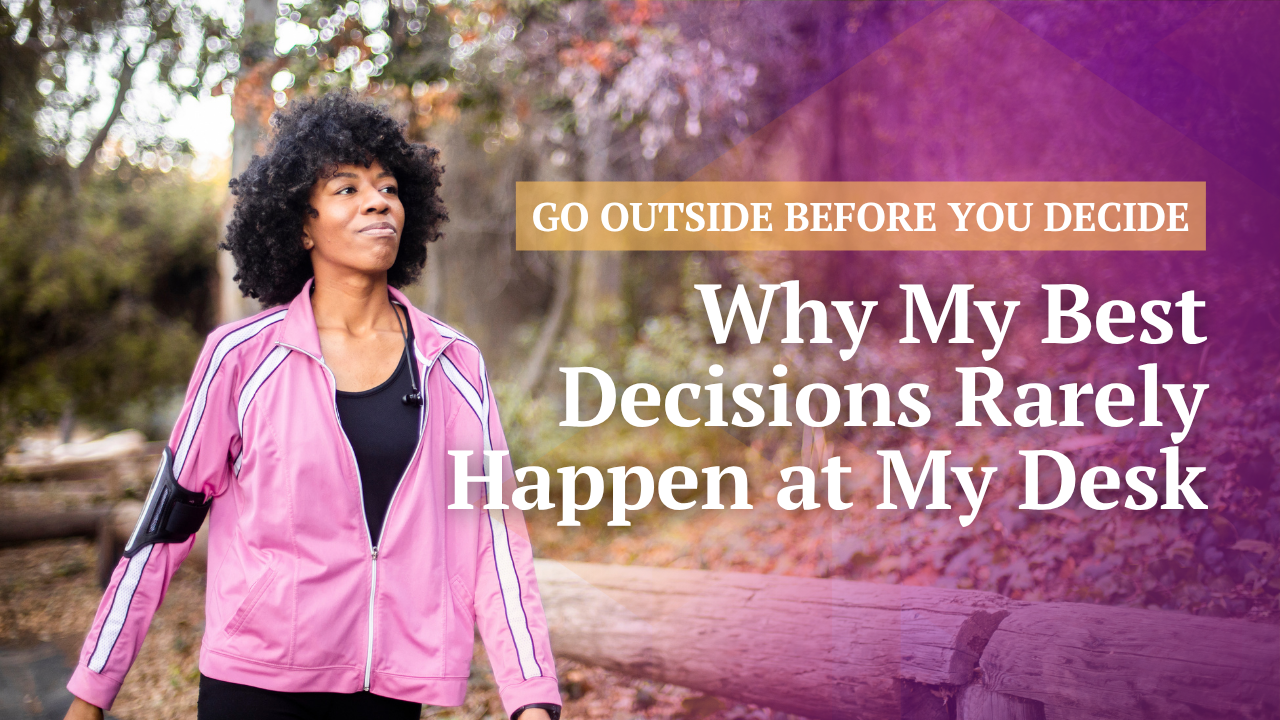
A few weeks ago, I found myself wrestling with a decision.
I am currently writing a book about ADHD and, for the first time in my career, I plan to seek a literary agent rather than self-publish. As I began learning about the publishing process, one recommendation kept appearing.
Build your audience.
My first reaction?
Marketing.
I'll be honest. I don't enjoy marketing.
I enjoy teaching.
I enjoy writing.
I enjoy helping clients understand themselves more deeply.
Marketing has always felt like something I should do rather than something that naturally energizes me.
But the more I sat with the advice, the more another question began to emerge.
What if building an audience wasn't really about marketing?
What if it was about making sure the people who need this information have a way to find it?
One idea kept returning.
Should I start an ADHD group?
Not because I wanted more followers.
Not because I needed another project.
But because I know what happens when people living with ADHD realize they are not broken, lazy, or alone. There is something profoundly healing about discovering that other people have spent their lives asking the same questions and struggling with the same invisible challenges.
It seemed like a good idea.
But was it the right idea?
So I did what I have learned to do whenever I am facing an important decision.
I stopped trying to solve the problem.
I went outside.
Not because walking magically solves problems.
Not because trees whisper answers.
And not because avoiding difficult decisions makes them easier.
I walk because I have learned that I think differently when my body remembers it belongs to something bigger than four walls.
I usually walk in my suburban neighborhood surrounded by trees and birdsong. However, there have been times when I walk through Manhattan. Surprisingly, both work, although nature usually gets me there a little faster.
The scenery helps.
The movement helps.
The fresh air helps.
But I think something deeper is happening.
The problem rarely changes.
I do.
My breathing slows.
My shoulders drop.
The urgency begins to dissolve.
Questions that felt tangled start to untie themselves.
Sometimes I come home with a different answer.
More often, I come home with the same answer I already had, but now I trust it.
That distinction matters.
The walk doesn't always give me clarity.
It creates the conditions where clarity can emerge.
As both a psychologist and a mystic, I have come to believe something that modern neuroscience increasingly supports.
Our minds do not operate independently of our bodies.
And our bodies do not operate independently of our environments.
Your Brain Was Never Designed to Live at a Desk
Many of us spend our days under artificial lighting, looking at screens, sitting almost perfectly still while expecting our brains to solve increasingly complex problems.
Then we become frustrated when we feel mentally stuck.
Research suggests our brains simply were not designed for that.
Every decision we make throughout the day quietly consumes mental energy. Psychologists refer to this as decision fatigue. By the time we reach an important decision, our brain has often spent hours making hundreds of smaller ones.
What should I answer?
What should I wear?
Which email comes first?
Should I say yes?
Should I say no?
Eventually, the brain becomes tired.
Trying harder isn't always the solution.
Sometimes the solution is recovering the mental resources we have already spent.
Nature Gives Our Attention Somewhere to Rest
Environmental psychologist Stephen Kaplan proposed Attention Restoration Theory, suggesting that natural environments replenish our capacity for directed attention after prolonged mental effort (Kaplan, 1995).
In simple terms...
Nature asks just enough of our attention to keep us present, but not so much that it overwhelms us.
The leaves move.
Birds sing.
Clouds drift.
Nothing demands an immediate response.
That quiet fascination allows the parts of our brain responsible for sustained attention to recover.
Research has repeatedly shown that spending time in nature improves attention, working memory, and cognitive functioning (Berman et al., 2008).
In other words...
Sometimes your brain doesn't need another productivity strategy.
It needs a tree.
Walking Changes the Way We Think
Movement matters too.
Researchers Marily Oppezzo and Daniel Schwartz (2014) found that walking significantly increased creative thinking compared to sitting.
That doesn't surprise me.
Long before neuroscience caught up, philosophers seemed to understand this intuitively.
Aristotle was famous for teaching while walking, giving rise to the Peripatetic school of philosophy. More recently, Steve Jobs became known for holding walking meetings, believing that movement encouraged better thinking and more creative conversations.
Perhaps they all noticed the same thing.
Movement changes thinking.
Not because our muscles solve problems.
Because our nervous system does.
The Nervous System Before the Mind
One of the biggest lessons I have learned, both personally and professionally, is that clarity is difficult when the nervous system believes there is an emergency.
Stress hormones like cortisol narrow our attention.
That narrowing is incredibly useful if a bear is chasing us.
It is much less useful when we are trying to decide whether to change careers, start a business, write a book, or have a difficult conversation.
When the nervous system settles, perspective widens.
Suddenly there are more than two options.
Suddenly we notice possibilities we literally could not see before.
Sometimes what changes is not the problem.
It is the person looking at it.
Spirit Speaks Softly
People sometimes ask how I integrate psychology and spirituality.
For me, they have never been separate.
Walking has become one of my spiritual practices because it creates space.
Not just space around me.
Space within me.
I pray.
I notice.
I listen.
I pay attention to what keeps returning instead of chasing every anxious thought that passes through my mind.
I have learned that anxiety is loud.
Spirit usually isn't.
Whether you understand that quiet knowing as intuition, wisdom, your subconscious, or the voice of God is less important than recognizing this:
It is difficult to hear whispers while living in constant mental noise.
When I returned from that walk, I realized the question was never, 'Should I build an audience?' The question was, 'How can I better serve the people this book is meant to reach?' Once I asked the right question, the decision almost made itself.
Try This
The next time you're facing an important decision, resist the urge to think harder.
Instead, change your environment first.
1. Leave Your Desk
What it is: Stepping away from the place where you've been trying to force an answer.
Why it works: Changing your physical environment interrupts repetitive thought patterns and gives your nervous system an opportunity to settle.
How to do it: Take a 20-minute walk before making the decision. If possible, choose a route with trees, water, or open space.
2. Walk Without Solving
What it is: Allowing yourself to move without mentally rehearsing every possible outcome.
Why it works: The brain often finds clarity when it is not under pressure to produce it immediately.
How to do it: Notice your surroundings. Feel your feet hitting the ground. Let the question accompany you without demanding an answer.
3. Pay Attention to Your Body
What it is: Checking your nervous system before trusting your thoughts.
Why it works: Stress changes perception. A calmer body often sees more clearly.
How to do it:
Ask yourself: "Do I feel settled enough to make this decision today?" If the answer is no, your body may be offering valuable information.
4. Listen for What Remains
What it is: Paying attention to the ideas that remain after the mental noise quiets down.
Why it works: The deepest truths are often consistent. Anxiety changes its story every few minutes. Wisdom usually doesn't.
How to do it:
After your walk, ask yourself: "What answer keeps returning when I become quiet?"
If you're constantly feeling mentally overwhelmed, emotionally exhausted, or stuck in survival mode, your nervous system may be trying to tell you something.
One walk won't solve chronic stress.
But it might help you recognize that you've been carrying more than you realized.
If that sounds familiar, my Hidden Stress Quiz can help you identify the often-overlooked signs that stress is affecting your mind, body, and relationships before burnout takes hold.
Because sometimes the first step toward clarity isn't making a decision.
It's giving your nervous system permission to breathe.
References
Berman, M. G., Jonides, J., & Kaplan, S. (2008). The cognitive benefits of interacting with nature. Psychological Science, 19(12), 1207-1212.
Kaplan, S. (1995). The restorative benefits of nature: Toward an integrative framework. Journal of Environmental Psychology, 15(3), 169-182.
Oppezzo, M., & Schwartz, D. L. (2014). Give your ideas some legs: The positive effect of walking on creative thinking. Journal of Experimental Psychology: Learning, Memory, and Cognition, 40(4), 1142-1152.