Grateful for My ADHD? It’s Complicated: Why Understanding ADHD Strengths Doesn’t Mean Ignoring the Struggle
Nov 03, 2026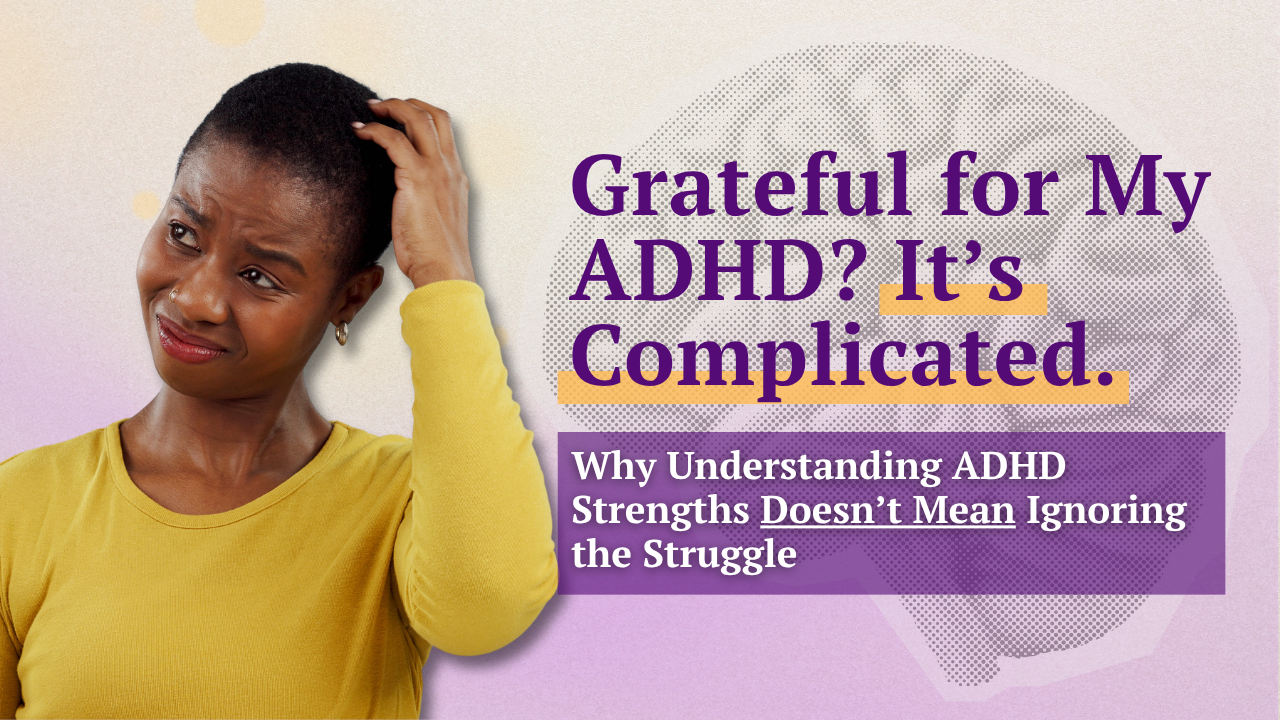
Near the end of an ADHD evaluation, I asked Maya a question she clearly wasn’t expecting.
“What do you appreciate about the way your brain works?”
She looked at me for a moment.
“About my ADHD?”
“About you.”
That didn’t make the question any easier.
Maya had come to me because she wanted to understand why certain parts of her life seemed so much harder than they should be. She was intelligent and professionally successful, but keeping up with the ordinary demands of life exhausted her. She procrastinated until deadlines became emergencies. She regularly underestimated how long things would take. Her home could go from organized to chaotic surprisingly quickly, and although she rarely missed an important work deadline, accomplishing that often required late nights and considerable stress.
She had spent years wondering why someone capable of doing difficult things could struggle so much with seemingly simple ones.
During her ADHD evaluation, we talked about all of that. We discussed her childhood, school experiences, relationships, work, emotional regulation, attention, executive functioning, and the strategies she had developed over the years to compensate for areas that were difficult for her.
But I also asked a lot about her strengths.
At one point she laughed and said, “I didn’t realize we were going to spend this much time talking about what I’m good at.”
That’s when I asked what she appreciated about the way her brain worked.
After thinking about it, Maya told me she loved how curious she was. When something caught her interest, she wanted to know everything about it. She made connections other people sometimes missed. She could become deeply immersed in an idea and emerge hours later with something creative that surprised even her. She was enthusiastic, spontaneous, and often the person who brought energy into a room.
Then she paused.
“But I don’t know if I’m grateful for ADHD.”
I told her she didn’t have to be.
Gratitude Doesn’t Require Romanticizing ADHD
As we move into a month when we’re encouraged to think about gratitude, I think there is room for a more complicated conversation about ADHD.
There has been an important shift toward talking about ADHD strengths. That’s valuable. For a long time, we discussed ADHD almost entirely in terms of deficits: distractibility, disorganization, impulsivity, poor time management, difficulty following through.
That isn’t the whole person.
Research examining strengths reported by adults with ADHD has identified qualities such as creativity, hyperfocus, humor, spontaneity, and high energy among characteristics some adults associate positively with their ADHD experience (Sedgwick et al., 2019). At the same time, ADHD is associated with real functional impairments across multiple areas of life (Faraone et al., 2021).
Both deserve space in the conversation.
I sometimes hear ADHD described as a “superpower.” I understand why that language appeals to people, particularly those who have spent much of their lives hearing what is wrong with them. Reclaiming parts of yourself that have been criticized can be powerful.
But we don’t have to turn ADHD into a gift in order to stop treating it as a character flaw.
Maya’s creativity was a real superpower.
So was the shame she felt when she missed something important.
Her enthusiasm was a real superpower.
So was the exhaustion of constantly trying to catch up.
Her ability to become deeply absorbed in something fascinating was a real superpower.
So was her difficulty starting tasks that mattered to her when they didn’t provide the same stimulation.
Gratitude doesn’t require choosing one version of the story.
Are These Really “ADHD Strengths”?
There isn’t an official list of ADHD superpowers, and having ADHD doesn’t automatically make someone creative, energetic, intuitive, funny, entrepreneurial, or passionate. People without ADHD can have those qualities too.
So when I explore strengths during an ADHD evaluation, I’m not trying to prove that ADHD has secretly given someone special abilities.
I’m trying to understand the whole person.
If we spend an evaluation asking only what someone forgets, loses, avoids, interrupts, or fails to complete, we can produce a very detailed description of difficulty while missing important information about how that person actually moves through the world.
Strengths also tell us something clinically useful.
What captures this person’s attention? When do they function particularly well? What environments bring out their best? What kinds of problems do they enjoy solving? What have they developed in response to challenges? What resources can we build upon when creating systems that support them?
For Maya, curiosity was particularly important.
She struggled when she tried to force herself through tasks using some version of You should just do this. But she became much more engaged when we approached a problem as something to investigate.
Instead of, “Why can’t I stay organized?” we could ask, “What makes it easier for me to stay organized?”
Instead of, “Why do I always procrastinate?” we could ask, “What changes on the occasions when I start something easily?”
Curiosity became more than something Maya appreciated about herself. It became something we could use.
Gratitude Can Include the Support You Needed
There was another part of Maya’s assessment that I didn’t want gratitude to erase.
She was angry.
Once we began making sense of patterns that had existed since childhood, she wondered why nobody had noticed. Why had so many people commented on her inconsistency without wondering what was underneath it? Why had she spent so many years thinking that if she could just become more disciplined, everything would finally fall into place?
Those feelings didn’t disappear because we had also identified strengths.
Nor did they need to.
Sometimes gratitude after an ADHD diagnosis isn’t gratitude for ADHD itself.
You might be grateful that you finally have language for experiences you couldn’t explain.
You might be grateful for the therapist who understood.
You might be grateful for accommodations, medication, coaching, technology, or the people who help you create structure.
You might be grateful that you finally understand why a strategy everyone insisted should work for you never did.
You might simply be grateful that you no longer have to interpret every difficulty as a personal failure.
That’s a different kind of gratitude.
Try This: Practice Gratitude Without Forcing Positivity
1. Ask what you appreciate about your brain
What it is: Shift the question from whether you are grateful for ADHD to what you appreciate about the way you think, feel, create, connect, or solve problems.
Why it works: It allows you to recognize strengths without having to attribute every positive quality to ADHD.
How to do it: Finish the sentence, “One thing I appreciate about the way my mind works is…” Don’t worry about whether ADHD caused it. You’re noticing something valuable about you.
2. Notice strengths alongside struggles
What it is: When you identify an ADHD-related difficulty, resist allowing it to become the entire description of yourself.
Why it works: Executive functioning difficulties can have significant consequences, but they don’t provide a complete picture of a person’s abilities or identity.
How to do it: When you catch yourself saying, “I’m so disorganized,” add another equally true fact about yourself: “Organization is difficult for me, and I’m very good at solving unexpected problems.” You aren’t canceling the difficulty. You’re widening the picture.
3. Be grateful for support, not just independence
What it is: Notice the people, tools, systems, and accommodations that make your life easier.
Why it works: We often treat needing support as evidence that we aren’t functioning well enough. In reality, effective support can reduce unnecessary demands on executive functioning and make it easier to use our abilities where they matter most.
How to do it: Identify one support that quietly makes your life better. It might be your calendar, medication, a partner, a therapist, a reminder on your phone, an accommodation at work, or the basket beside the door that keeps you from losing your keys. Let it count.
4. Let gratitude and frustration coexist
What it is: Give yourself permission to appreciate aspects of your brain while still wishing other things were easier.
Why it works: Gratitude becomes less useful when it requires denying difficult experiences. A more complete understanding can hold strengths and impairments at the same time.
How to do it: Try completing both sentences: “I’m grateful for…” and “I wish it were easier to…” Don’t make one correct the other.
The Whole Picture
When Maya returned for her feedback session, we talked about the findings from her evaluation, including the areas where ADHD was creating meaningful difficulties.
And then we talked about her strengths again.
This time, she wasn’t surprised.
“I’ve spent so much time trying to fix the things I’m bad at,” she said. “I don’t think I’ve ever thought about building around what I’m good at.”
That may be one of the most valuable things that can come from understanding your brain.
An ADHD diagnosis should help explain difficulties. It can guide treatment, accommodations, coaching, and practical changes. But I don’t believe an assessment should leave someone with a beautifully documented list of everything that’s wrong with them.
I want to know what is working, too.
Maya didn’t leave our work suddenly grateful that she had ADHD. She was still frustrated by some of the ways ADHD affected her life, and we began creating systems to address them.
But she was becoming grateful for something else.
A fuller understanding of herself.
And perhaps that’s enough.
Wondering Whether ADHD Might Explain Your Own Experience?
A comprehensive ADHD evaluation isn’t only about identifying symptoms. My approach also explores the strengths, strategies, experiences, and patterns that make you who you are.
If you’ve spent years wondering why some things seem harder than they should, an evaluation can help you replace guessing with a clearer understanding of what’s actually happening.
Learn more about ADHD evaluations or schedule a free consultation.
Disclaimer
Maya's details have been changed to protect confidentiality. This article is intended for educational purposes and is not a substitute for individualized psychological evaluation, diagnosis, or treatment.
References
Faraone, S. V., Banaschewski, T., Coghill, D., et al. (2021). The World Federation of ADHD International Consensus Statement: 208 evidence-based conclusions about the disorder. Neuroscience & Biobehavioral Reviews, 128, 789–818.
Sedgwick, J. A., Merwood, A., & Asherson, P. (2019). The positive aspects of attention deficit hyperactivity disorder: A qualitative investigation of successful adults with ADHD. ADHD Attention Deficit and Hyperactivity Disorders, 11, 241–253.