Why Do I Keep Starting Over? How an ADHD Evaluation Can Help You Move Forward
Sep 29, 2026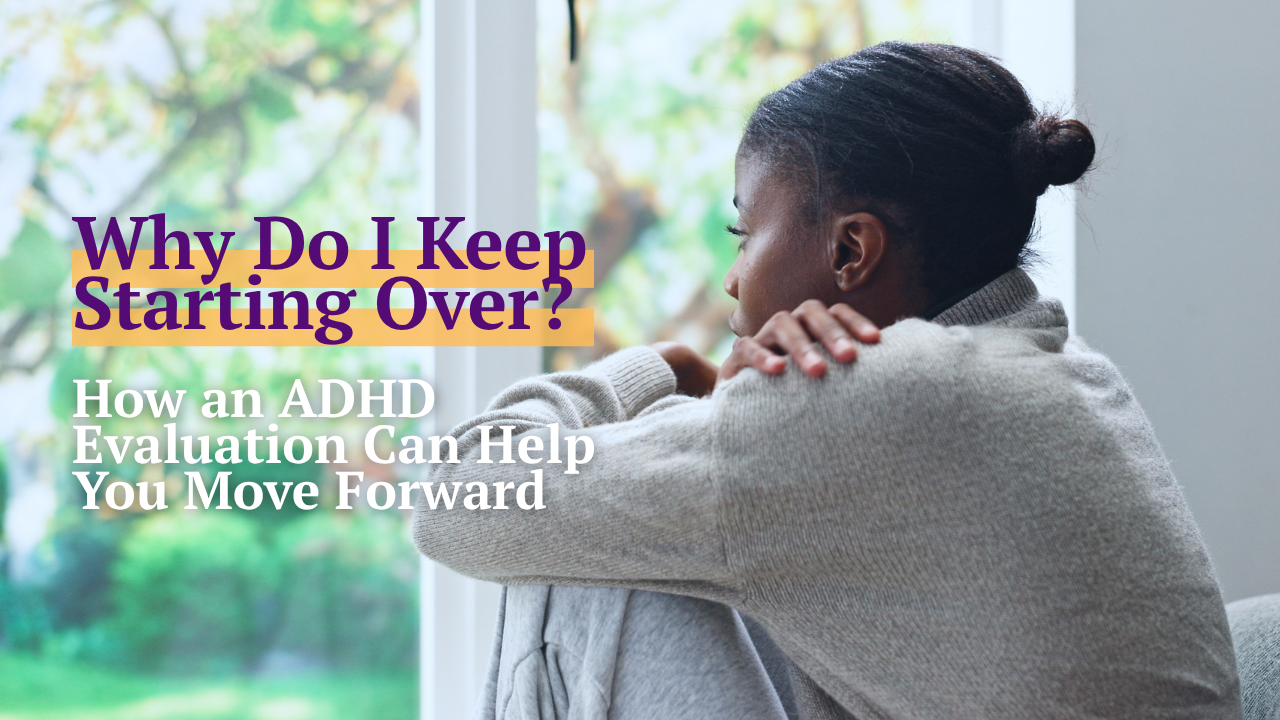
One afternoon, a woman I'll call Ada met with me virtually for an evaluation. Before we even began, she laughed and said, "I almost canceled this appointment."
I asked why.
She smiled, shook her head, and said, "Because I was embarrassed. I kept thinking that if I could just get myself together, I wouldn't need to be here."
I told her I was glad she hadn't.
Her sentence stayed with me because, after nearly thirty years as a psychologist, I've heard versions of it countless times.
People don't usually come to an ADHD evaluation just because they want a diagnosis. They come because they're tired of asking themselves the same question over and over again.
"Why does this keep happening?"
As we talked, Ada described a pattern that had followed her for most of her life. Every few months she would decide it was time for a fresh start. Sometimes it was January. Sometimes it was after her birthday. More often than not, it was September.
There was something about the beginning of the school year that always filled her with hope. Even as an adult, September felt like possibility. She would buy a new planner, reorganize her desk, clear out old emails, make lists, and promise herself that this time she would finally stay on top of everything.
For a while, it worked.
Then life happened.
A busy week at work. A sick child. An unexpected deadline. A vacation. One missed appointment. One forgotten phone call. One pile of unopened mail.
Within a few weeks she felt as though everything had slipped through her fingers again.
"I don't understand it," she told me. "I know how to be organized. I've read the books. I've bought the planners. I even enjoy setting everything up. I just can't seem to keep it going."
As she spoke, I wasn't listening for isolated symptoms. I was listening for patterns. After years of conducting ADHD evaluations, I've learned that many people who seek them have become experts at blaming themselves. They have spent years assuming they simply weren't disciplined enough, weren't trying hard enough, or just needed to find the right system. The story beneath the story is often where the answers begin to emerge.
Ada had reached the same conclusion. She had convinced herself that each setback meant she needed to start over, yet again.
She didn't see the dozens of successful projects she had completed or the career she had built. She saw the unopened mail on the kitchen counter, the forgotten birthday card, and the planner that looked beautiful for three weeks before it was tucked into a drawer.
As I asked about her childhood, school years, and work history, the pattern became clearer.
Teachers had described her as bright but easily distracted.
She often finished assignments at the last minute, not because she didn't care, but because she struggled to get started until the deadline was unavoidable.
Her bedroom had always been messy despite her best intentions.
She interrupted conversations, misplaced things, and frequently underestimated how long tasks would take. None of those experiences, by themselves, seemed remarkable. Taken together, however, they told a story that neither she nor anyone else had ever stopped to consider.
Because Ada had done well in school and built a successful career, everyone assumed she was simply a little disorganized.
She assumed the same thing.
When people think about ADHD, they often picture the little boy who can't sit still in elementary school. Many adults, especially women and high-achieving professionals, never see themselves in that stereotype. They learn to compensate, work longer hours, rely on reminders, or push themselves harder than everyone around them. From the outside, they often appear successful.
What other people don't see is how exhausting it can be to hold everything together.
About halfway through our conversation, Ada became quiet. Then she asked a question I hear surprisingly often.
"Are you telling me that this isn't because I'm lazy?"
I told her we weren't finished with the evaluation yet, and it would have been premature to draw conclusions. My job was to understand the whole picture before offering any answers.
But I also told her something else.
"I don't hear laziness in your story. I hear someone who has been working incredibly hard for a very long time."
She started to cry.
Not because we had reached a diagnosis.
We hadn't.
She cried because, for the first time in years, someone was looking for an explanation instead of another reason to criticize her.
That moment is one of the reasons I believe comprehensive evaluations matter.
They are not about finding a label to place on someone. They are about understanding the patterns that have shaped a person's life so that the next chapter can be written with greater clarity than the last.
Sometimes the greatest relief isn't hearing an answer.
It's realizing you've finally been asking the right question. Sometimes the evaluation confirms ADHD. Sometimes it points in a different direction altogether. Either way, the goal is the same: to replace years of self-criticism with a clearer understanding of what is really happening.
Ada's evaluation eventually confirmed that ADHD was an important part of her story, but it wasn't the whole story.
Like many comprehensive psychological evaluations, ours explored much more than one possible diagnosis. We talked about anxiety, stress, sleep, medical history, childhood experiences, work demands, and the ways she had learned to adapt over the years. We used standardized measures, reviewed her developmental history, and looked for patterns that had been present across different stages of her life. We also evaluated her strengths.
That is what a comprehensive ADHD evaluation is designed to do. It isn't about proving that someone has ADHD. It's about understanding why life has felt the way it has and identifying the factors that best explain those lifelong patterns.
Sometimes ADHD is the answer. Sometimes it isn't. Sometimes anxiety, depression, trauma, sleep disorders, medical conditions, or a combination of factors better explain what someone has been experiencing. A good evaluation doesn't begin with a conclusion. It begins with curiosity.
For Ada, understanding those lifelong patterns changed something profound.
Her calendar didn't suddenly stay organized.
She didn't wake up one morning with perfect executive functioning.
But she stopped interpreting every forgotten appointment or unfinished project as evidence that she was somehow failing at adulthood.
Instead of asking, "What's wrong with me?" she began asking, "Knowing what I know now, what supports would help my brain succeed?"
That is a very different question.
Research consistently shows that adults with ADHD often experience years of self-criticism before receiving an accurate diagnosis. Many report lower self-esteem, chronic feelings of underachievement, and emotional distress that stem not simply from ADHD symptoms themselves, but from repeatedly believing those symptoms reflected personal failings rather than differences in how their brains function (Barkley, 2015; Faraone et al., 2021).
When we replace shame with understanding, something important happens.
People stop trying to become someone else.
They begin learning how to work with the brain they have.
That shift doesn't solve every problem overnight, but it creates the foundation for meaningful and lasting change. I've watched many people discover that once they understand how their brain works, they stop spending so much energy fighting themselves. That energy can then be redirected toward building a life that works with their brain instead of against it.
Four Shifts That Can Change Everything
Whether or not ADHD is part of your story, these ideas may help you approach yourself with greater understanding.
1. Stop measuring effort by the outcome.
Many adults judge themselves solely by what they accomplished.
Did I finish the project?
Did I remember every appointment?
Did I keep the house organized?
Those questions matter, but they don't tell the whole story.
Two people can complete the exact same task while expending dramatically different amounts of mental effort. If it takes everything you have to stay organized, that doesn't mean you're weak. It means your brain may be working much harder than anyone else realizes.
The goal isn't to compare yourself to someone else's process.
It's to better understand your own.
2. Look for patterns instead of isolated failures.
One forgotten appointment happens to everyone.
So does losing your keys.
What matters is the larger picture.
Have these challenges followed you since childhood?
Do they show up at home, at work, and in relationships?
Do you consistently underestimate how long tasks will take or struggle to get started despite genuinely wanting to?
Psychologists don't diagnose ADHD based on one difficult day.
We look for patterns that persist across time and settings.
You can begin doing the same with curiosity instead of criticism.
3. Build systems that fit your brain.
One of the biggest mistakes I see is people trying to force themselves into organizational systems that were designed for someone else.
Instead of asking, "Why can't I stick with this planner?" ask, "What actually helps me remember things?"
For one person, that might be a paper calendar.
For another, it's a digital reminder that repeats until they complete the task.
Someone else may benefit from visual cues placed where they can't be ignored.
There isn't one right system.
There is only the system that works consistently for you.
4. Don't be afraid to seek clarity.
Many people delay an evaluation because they're afraid of what they might hear.
Ironically, they often spend years living with much harsher explanations.
"I'm lazy."
"I'm irresponsible."
"I'm just not trying hard enough."
A comprehensive evaluation doesn't define who you are.
It gives you better information.
Whether the answer is ADHD or something entirely different, understanding what's really happening allows you and your healthcare providers to make informed decisions about treatment, accommodations, coaching, therapy, medication, or lifestyle strategies.
Knowledge isn't a label.
It's a starting point.
When I think back to Ada, I don't remember her because she received an ADHD diagnosis.
I remember her because of what happened several months later.
During a follow-up coaching conversation, she smiled and said, "I'm not starting over anymore."
She still used a planner.
She still forgot things occasionally.
She still had difficult weeks.
But she no longer believed those moments meant she was broken.
Instead of constantly trying to become a different person, she was learning how to support the person she had always been.
I think about that often because it captures what I hope every evaluation provides. Not perfection, an excuse, or simply a diagnosis. I hope it provides understanding.
Sometimes the most important outcome of an evaluation isn't the diagnosis itself.
It finally offers an explanation that lets you replace years of self-judgment with self-compassion and practical next steps.
Thinking About an ADHD Evaluation?
If you've spent years wondering why organization, follow-through, time management, or emotional regulation seem harder for you than they do for others, you don't have to keep guessing.
A comprehensive ADHD evaluation can help clarify whether ADHD is part of the picture or whether another explanation better fits your experiences. Either way, clarity is valuable because it helps you move forward with confidence rather than self-doubt.
If Ada's story felt familiar, you don't have to keep wondering. A comprehensive ADHD evaluation can help answer questions you may have been asking yourself for years. Whether the outcome is ADHD, another diagnosis, or simply a better understanding of your strengths and challenges, clarity is often the first step toward lasting change. If you're ready to explore those questions, I'd be honored to walk that journey with you.
⟶ Learn about Virtual Adult ADHD Focused Evaluation here
Disclaimer
Ada is a composite character created from the experiences of many clients. Identifying details have been changed to protect confidentiality.
References
Barkley, R. A. (2015). Attention-Deficit Hyperactivity Disorder: A Handbook for Diagnosis and Treatment (4th ed.). Guilford Press.
Faraone, S. V., Asherson, P., Banaschewski, T., et al. (2021). The World Federation of ADHD International Consensus Statement: 208 evidence-based conclusions about the disorder. Neuroscience & Biobehavioral Reviews, 128, 789-818.
American Psychiatric Association. (2022). Diagnostic and Statistical Manual of Mental Disorders (5th ed., text rev.; DSM-5-TR). American Psychiatric Association Publishing.