Why Successful People with ADHD Often Think They’re Lazy: The Hidden Difference Between Inconsistent Performance and Lack of Effort
Oct 06, 2026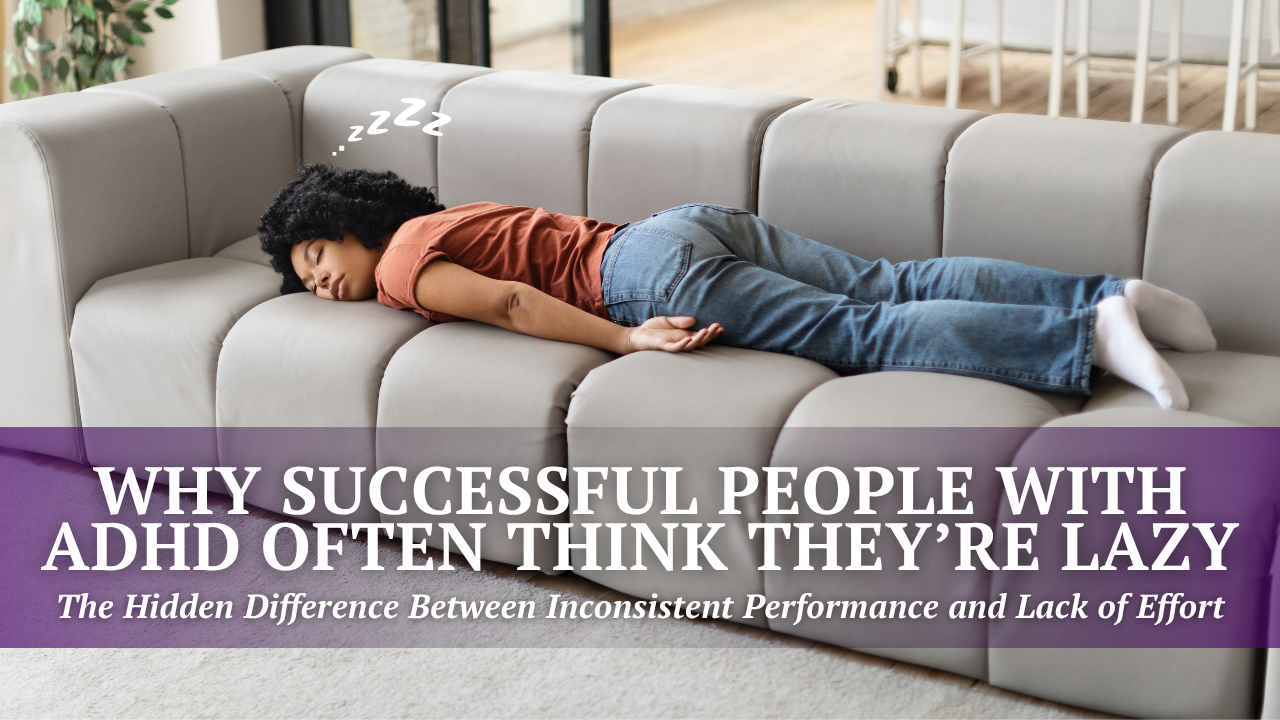
When Kim logged on for her ADHD evaluation, she apologized before we had exchanged more than a few sentences. “I’m embarrassed to admit this,” she said. “I’m a university professor, and I can’t seem to keep up with my grading.”
I asked her to tell me more.
Kim was a good professor. In fact, teaching was the part of her job where she shined. Her classes filled quickly, students stayed after class to continue conversations, and former students sometimes contacted her years later to tell her how much they had learned from her. She could take a complicated idea and make it understandable, relevant, and interesting. When I asked what she loved most about her work, she didn’t hesitate. “My students.”
But the rest of the job was another story. Grading took forever. Emails accumulated faster than she could answer them. Committee deadlines seemed to sneak up on her even when they had been on her calendar for weeks. Her office was filled with stacks of papers she intended to organize, and she regularly spent evenings and weekends catching up on work she had planned to finish during the week.
Every semester started with optimism. Kim would map out her grading schedule, block time on her calendar, and promise herself that this semester she would stay ahead. Then a few particularly engaging classes would inspire her to revise a lecture or spend extra time helping students. A meeting would run long. She would put off grading for one night, then another, and suddenly she had dozens of papers waiting for her.
“I know exactly what I’m supposed to do,” she told me. “That’s what makes it so frustrating. I’m a professor. I have a Ph.D. I should be able to manage my time.”
Then she said what she had apparently been telling herself for years: “I think I’m just lazy.”
That word caught my attention, because Kim had just spent nearly an hour describing an enormous amount of effort. She wasn't avoiding work altogether. She was teaching, mentoring students, preparing lectures, attending meetings, answering emails, conducting research, and then staying up late trying to finish the work she hadn’t managed to complete during the day. Whatever was happening, a lack of effort didn’t seem to explain it very well.
As we continued the evaluation, I listened for patterns across Kim’s life. In graduate school, she had often waited until deadlines were close before she could fully engage with papers. She frequently underestimated how long tasks would take. She could become deeply absorbed in work she found interesting but struggled to begin repetitive tasks even when she knew they were important. She had developed countless ways of compensating over the years, and because those strategies had allowed her to succeed academically and professionally, neither she nor the people around her had considered ADHD.
That happens more often than many people realize. ADHD is a neurodevelopmental condition involving differences in attention regulation and executive functioning, including planning, organization, working memory, task initiation, and self-monitoring (Barkley, 2015; Faraone et al., 2021). Intelligence and achievement do not protect someone from having ADHD. Sometimes they simply provide enough scaffolding for the person to compensate for it.
The result can be a particularly painful contradiction: “If I’m capable of doing all of these difficult things, why can’t I do this simple thing?”
For Kim, that question had gradually become a judgment about her character. She had confused inconsistent performance with lack of effort.
When Your Strengths Help Hide Your Struggles
As part of my ADHD evaluations, I don’t only assess challenges. I also evaluate strengths, because understanding how someone functions means understanding what works exceptionally well, not simply what is difficult.
Kim’s strengths profile revealed something that was already apparent from talking with her: one of her ADHD superpowers was enthusiasm.
She laughed when we discussed it. “My students would definitely agree with that.”
Her enthusiasm was contagious. It helped her connect ideas, respond spontaneously to students’ questions, and turn a lecture into a conversation people wanted to join. It was part of what made her an excellent professor.
It also helped mask the parts of her job that were much harder.
Her colleagues saw the engaging professor who walked into class prepared and energized. Her students saw the professor who remembered something they had said three weeks earlier and wanted to hear more. Neither group saw the mental gymnastics involved in getting grades submitted on time or the Sunday afternoons lost to tasks she had intended to finish on Thursday.
That matters because we often judge whether someone is struggling by looking at the final product. Kim had a Ph.D., a career, and students who valued her teaching, so she assumed she couldn’t possibly have a legitimate executive-functioning problem. She interpreted the amount of effort required to maintain that success as a personal weakness.
Research on adults with ADHD has documented impairments across multiple areas of daily functioning even among adults who have achieved educational and occupational success (Faraone et al., 2021). Achievement tells us what someone has accomplished. It doesn’t necessarily tell us how difficult it was to get there.
Once Kim understood that, we could ask a much more useful question. Instead of, “Why am I so lazy?” we could ask, “What makes some parts of my work easier for my brain than others, and what support do I need for the parts that are harder?”
That is where change becomes possible.
Try This: Look Beyond “Lazy”
1. Notice inconsistency instead of judging it
What it is: Pay attention to situations in which you can perform exceptionally well and situations in which getting started feels nearly impossible.
Why it works: ADHD does not necessarily produce an inability to focus. Attention can vary considerably depending on interest, novelty, urgency, and other factors. That inconsistency can easily be mistaken for a lack of motivation.
How to do it: For one week, notice when tasks feel relatively easy and when you get stuck. Instead of judging the difference, ask what changed. Was the task interesting? Urgent? New? Repetitive? Open-ended? The pattern may tell you more than the unfinished task does.
2. Account for the effort behind the outcome
What it is: Stop using achievement as the only measure of how well you are functioning.
Why it works: Compensating can hide executive functioning difficulties. If you meet every deadline by staying up until 2 a.m., the deadline was met, but that doesn’t necessarily mean the system is working well.
How to do it: When you complete something difficult, ask two questions: Did I get it done? and What did getting it done cost me? Both answers matter.
3. Build small, smart systems
What it is: Create simple external supports for the tasks that repeatedly create friction.
Why it works: Executive functioning demands decrease when the environment carries some of the load. Small, smart systems beat willpower because you are no longer asking your brain to remember, initiate, organize, and follow through entirely on its own.
How to do it: Choose one recurring problem rather than reorganizing your entire life. Kim, for example, didn’t need a new productivity system for her whole job. She needed better support around grading. Start with the place where you consistently get stuck and design one small system around it.
4. Include your strengths in the picture
What it is: Pay as much attention to what comes naturally to you as you do to what is difficult.
Why it works: A deficit-only view of ADHD can leave people believing they are a collection of problems to fix. Understanding strengths gives you information about the environments, activities, and strategies in which you are most likely to thrive.
How to do it: Ask yourself, What do people consistently come to me for? What do I do unusually well? When do I feel most engaged and capable? Don't dismiss the answers because those things feel easy to you. Sometimes what feels ordinary from the inside is a genuine strength.
When I met with Kim again after her evaluation, the grading had not magically become exciting. She still needed systems to help her initiate and manage it, and there were still parts of university life she would probably never enjoy as much as teaching.
What had changed was the meaning she attached to those difficulties.
“I still don't love grading,” she told me with a laugh. “But I don't hate myself anymore.”
That may sound like a small change. It isn't.
Kim could finally see the whole picture. She was a talented professor whose enthusiasm helped students become excited about learning, and she was also someone whose brain needed additional support with some of the administrative demands of her job. Both things could be true.
Understanding ADHD isn't about explaining away every difficulty or turning every ADHD characteristic into a strength. It is about replacing inaccurate judgments with better information. Once you understand where you struggle and where you thrive, you can stop wasting energy trying to become someone else and start building systems that support who you already are. When you understand your brain, you can begin building a life that works with it instead of against it.
Free for ADHD Awareness Month
Throughout October, I’m making my ebook, Organize Your Life: A Step-by-Step Guide for Adults and College Students Living with ADD/ADHD, available free. The book offers practical strategies for creating organization and structure that fit your life rather than expecting you to force yourself into someone else’s system.
→ Download the free ebook HERE
And if you recognize yourself in Kim’s story and have been wondering whether ADHD could explain patterns you’ve experienced for years, a focused ADHD evaluation can help you better understand both your challenges and your strengths. I would love to meet with you for a FREE CONSULTATION to talk about your needs.
Disclaimer
Kim is a composite character created from the experiences of multiple clients. Details have been changed to protect confidentiality. This article is intended for educational purposes and is not a substitute for an individualized psychological evaluation, diagnosis, or treatment.
References
Barkley, R. A. (2015). Attention-deficit hyperactivity disorder: A handbook for diagnosis and treatment (4th ed.). Guilford Press.
Faraone, S. V., Banaschewski, T., Coghill, D., et al. (2021). The World Federation of ADHD International Consensus Statement: 208 evidence-based conclusions about the disorder. Neuroscience & Biobehavioral Reviews, 128, 789–818.