The 10-Minute Reset: How Small Movements Improve Your Mood and Mental Health
Jul 21, 2026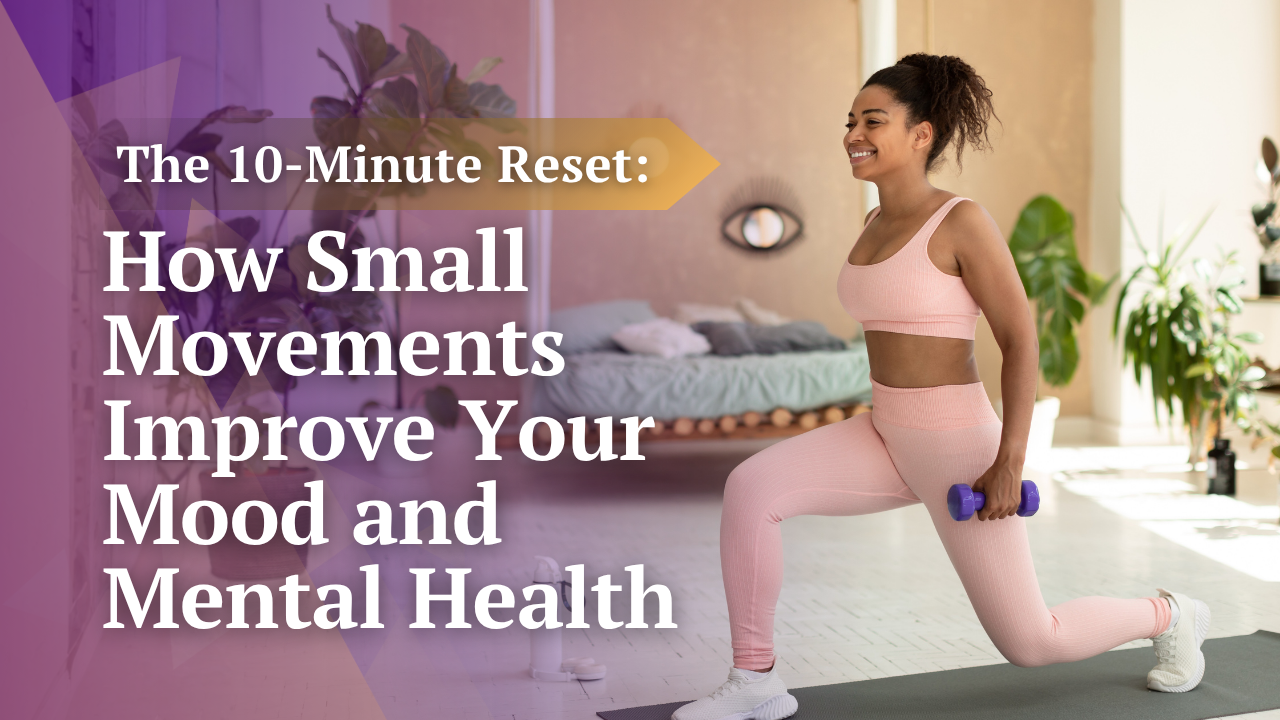
When people think about exercise, they often imagine the big things: gym memberships, hour-long workouts, special clothes, and the perfect routine.
But some of the most powerful shifts happen in the small moments we actually repeat.
For years, I’ve taught people that self-care has to fit into your real life. If the plan only works when everything is calm, your schedule is perfect, and nobody needs anything from you, it probably isn’t a real plan. Life is rarely that cooperative.
When My Work Changed, My Body Noticed
Before COVID, I moved more during my workday without thinking about it. After every therapy session, I stood up, walked my client to the door, moved around my office, and reset the space.
It wasn’t exercise. It was simply part of the natural rhythm of my day.
Then everything moved online.
Suddenly, my commute was a few steps. My clients entered and left with the click of a button. One session ended, another began, and I realized my body was barely moving. My brain was working all day, but my body had been removed from the process.
So I made one small change.
I replaced my desk chair with a yoga ball.
Not because I had some grand wellness plan. I simply realized my body needed movement built back into my day.
Small Movements Send Big Signals
Over time, that one change evolved. Now, after I finish my notes between clients, I take a few minutes to reset.
I bounce on my yoga ball. I do desk push-ups. I move.
Nothing fancy. Nothing that requires changing clothes, finding equipment, or blocking off an hour. Just enough movement to help me transition from one session to the next and clear my mind so I can be fully present for the next person sitting across from me.
Research supports the power of these small shifts. Even brief bouts of physical activity can improve mood, increase energy, and reduce feelings of stress (Reed & Ones, 2006). Movement influences neurotransmitters involved in mood regulation, including dopamine and serotonin, while also helping regulate the body’s stress response (Basso & Suzuki, 2017).
Your body and brain are always communicating. Movement changes the conversation.
Stop Waiting for the Perfect Workout
One of the biggest barriers to movement is all-or-nothing thinking.
“If I can’t work out for an hour, why bother?”
But your nervous system does not require perfection. It responds to consistency.
Small actions repeated over time become powerful because they become part of who we are. Research on habit formation shows that repeated behaviors connected to consistent cues become more automatic over time (Lally et al., 2010).
That’s why my movement happens after my notes.
The notes are the cue. Movement is the reset.
Movement Is Not Just for Your Body
We often talk about exercise as something we do to change how we look. But movement also changes how we feel.
A few minutes of movement can help release tension, shift energy, create a transition between tasks, interrupt stress, and reconnect us with ourselves.
For me, those few minutes are not about fitness. They are about caring for my nervous system so I can continue doing work that requires me to be emotionally present.
Movement creates space.
Inner Peace Is Built in Small Moments
Inner peace is not only found on a meditation cushion, during vacation, or when life finally slows down.
Sometimes inner peace looks like a few minutes bouncing on a yoga ball between responsibilities. Sometimes it looks like taking a walk around the block. Sometimes it looks like standing up, stretching, breathing, and reminding yourself that your body is not just something carrying your brain around all day.
It is part of you.
Try This
If movement feels overwhelming, start smaller.
1. Create a movement snack
What it is: A short burst of movement added into your existing day.
Why it works: Small actions lower resistance and help create sustainable habits.
How to do it: Pick one daily transition—after a meeting, before lunch, after finishing a task—and move for 2–5 minutes.
2. Pair movement with something you already do
What it is: Connecting a new habit to an existing routine.
Why it works: Habit research shows behaviors become easier when connected to consistent cues.
How to do it: Choose your “after I ___, I will ___” statement.
Example: “After I send my last email, I will stretch for two minutes.”
3. Ask what kind of movement your body needs
What it is: Choosing movement based on your nervous system instead of rules.
Why it works: Different states need different support. Sometimes you need energy; sometimes you need calming.
How to do it: Ask yourself: “Does my body need activation, release, or rest?”
Taking Care of the Whole Self
Movement is a powerful tool for mental health, but it is only one piece of the equation. Sometimes a walk, a stretch, or a few minutes of movement can help us reset. Other times, we need support understanding the patterns, beliefs, emotions, and experiences that keep us feeling stuck.
That is where therapy can help.
As part of my upcoming book, You Don’t Have to Be Crazy to See a Therapist, I’m sharing stories and tools to help people understand that caring for your mental health is not about being “broken.” It is about learning how to support yourself—mind, body, and spirit.
If you are considering therapy but aren’t sure where to begin, download my free guide, How to Interview a Therapist (So You Actually Find the Right One)—a practical guide to choosing a therapist who fits you, not the other way around.
⟶ Download the FREE guide here
References
Basso, J. C., & Suzuki, W. A. (2017). The effects of acute exercise on mood, cognition, neurophysiology, and neurochemical pathways: A review. Brain Plasticity, 2(2), 127–152.
Lally, P., van Jaarsveld, C. H. M., Potts, H. W. W., & Wardle, J. (2010). How are habits formed: Modeling habit formation in the real world. European Journal of Social Psychology, 40(6), 998–1009.
Reed, J., & Ones, D. S. (2006). The effect of acute aerobic exercise on positive activated affect: A meta-analysis. Psychology of Sport and Exercise, 7(5), 477–514.